The DIY Training Blueprint
If you’ve been training hard for more than 2-3 years, the noob gains have likely faded. Progress has probably stalled. You’re wondering when, if ever, the next “big win” will come.
Along the way you’ve probably tried every app under the sun and boiled your ears with information overload from podcasts, books, Instagram highlight reels, and YouTube how-to videos.
What’s worse is that you may have even paid a coach in time, money, and effort, only to be handed a PDF they ripped off from someone else’s book or website.
Sound familiar?
Let’s fix it.
Adapted from The Integrated Fitness Problem: Module 8 - Wisdom and Self-Directed Training.
Preface:
First, let’s set the foundation. The Cheshire Cat was right when he said “If you don’t know where you’re going, any road will get you there.” That’s why doing just about anything, consistently, still produces results, for a while. Dan John put it slightly different; “everything works, for about 6 weeks.”
The other problem is that if we try to train — which is to say intentionally improve — at everything all the time, that’s a surefire way to:
Get injured, or
Become exceedingly mediocre.
We must abide by the laws of specificity and accommodation. Specificity means that training provides a specific stimulus and recovery allows us to adapt to that stimulus. Novices easily “lose fat and gain muscle at the same time” or “get stronger and improve conditioning” when both attributes are under developed.
But, you’re not a novice anymore, right? Training like one won’t cut it.
Accommodation means that doing what got you here won’t get you to the next level. Each increasing layer of success will come with a diminishing return on investment. Difficulty of acquisition is part of how we determine value.
Step 1:
Make a commitment.
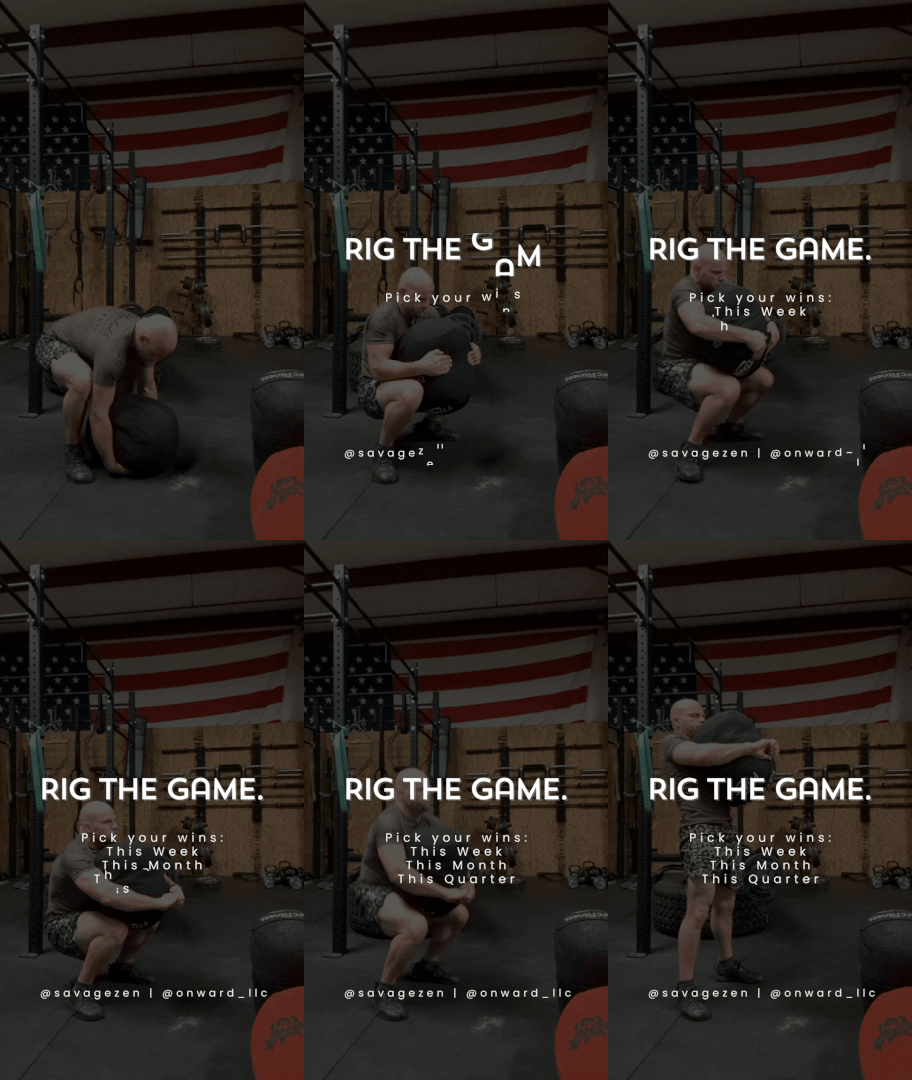
30-Day challenges are pretty cheap, that’s why everyone gives them away. So, for starters, I want you to define:
What does winning look like:
This week?
This month?
This quarter?
If you’re not willing to go 90 days in the wrong direction to learn something, you’re still a novice. That’s not an insult. You simply haven’t put in enough time yet to figure out what’s not working or where you need to specialize.
Step 2:
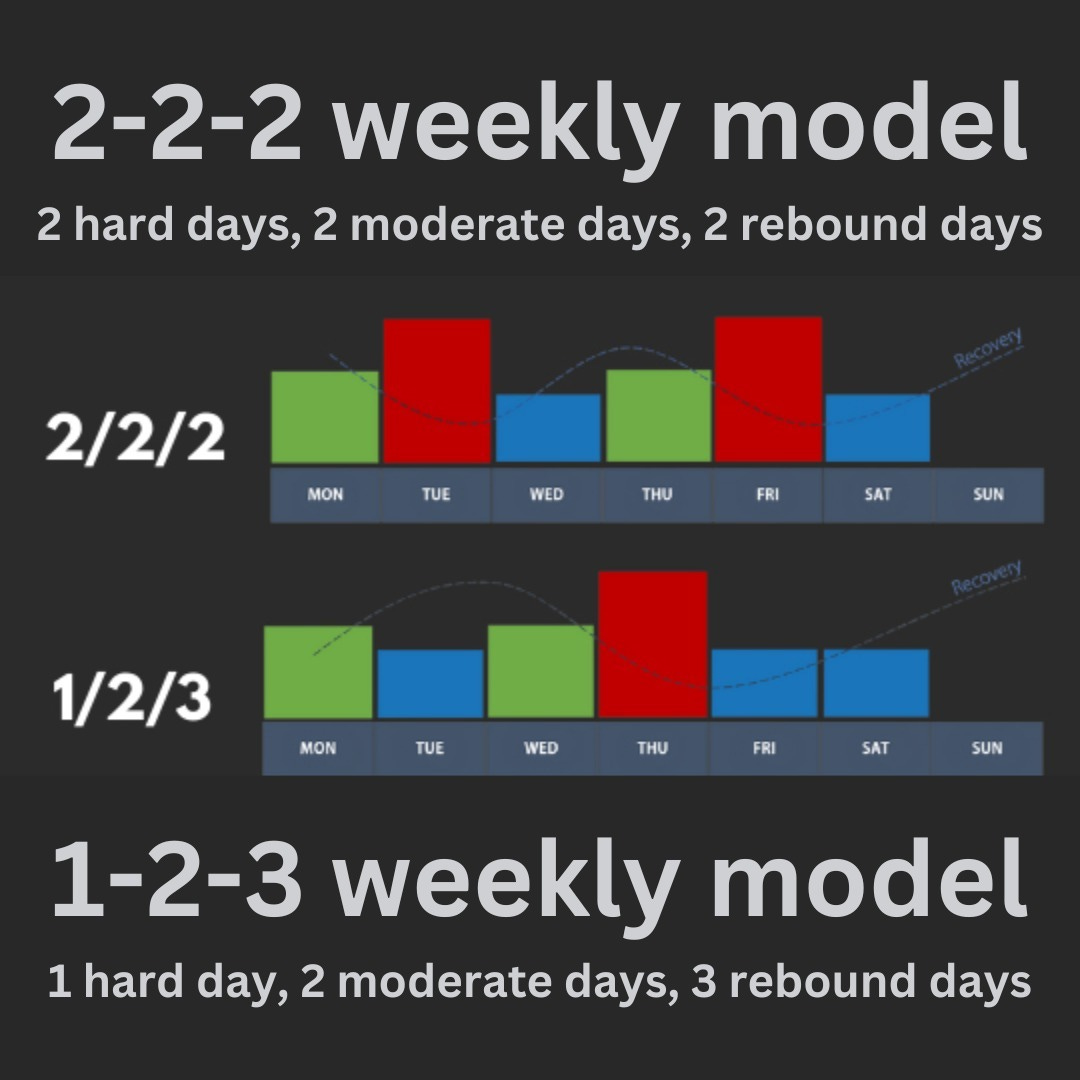
The micro-cycle formula.
So-called “deloading” usually isn’t necessary if we’ve managed load — physical, cognitive, and emotional — appropriately thus far. (Note: there are exceptions such as dedicated camps where the expectation is intended over-load.).
None of us are in kindergarten anymore, but gold stars and cookies still feel nice. So, we have to arrange for those rewards ourselves. In the simplest behavioral terms, we need to make the wrong thing difficult and the right thing easy (or at least fun).
If you’ve put more than 300 hours of focused effort into something, you’ve no doubt recognized that about 6/10 training sessions are so-so, 3/10 make you wonder why you even started, and maybe one is exceptionally good.
That’s a starvation diet. You can’t grow when you’re starving — or fighting for your life.
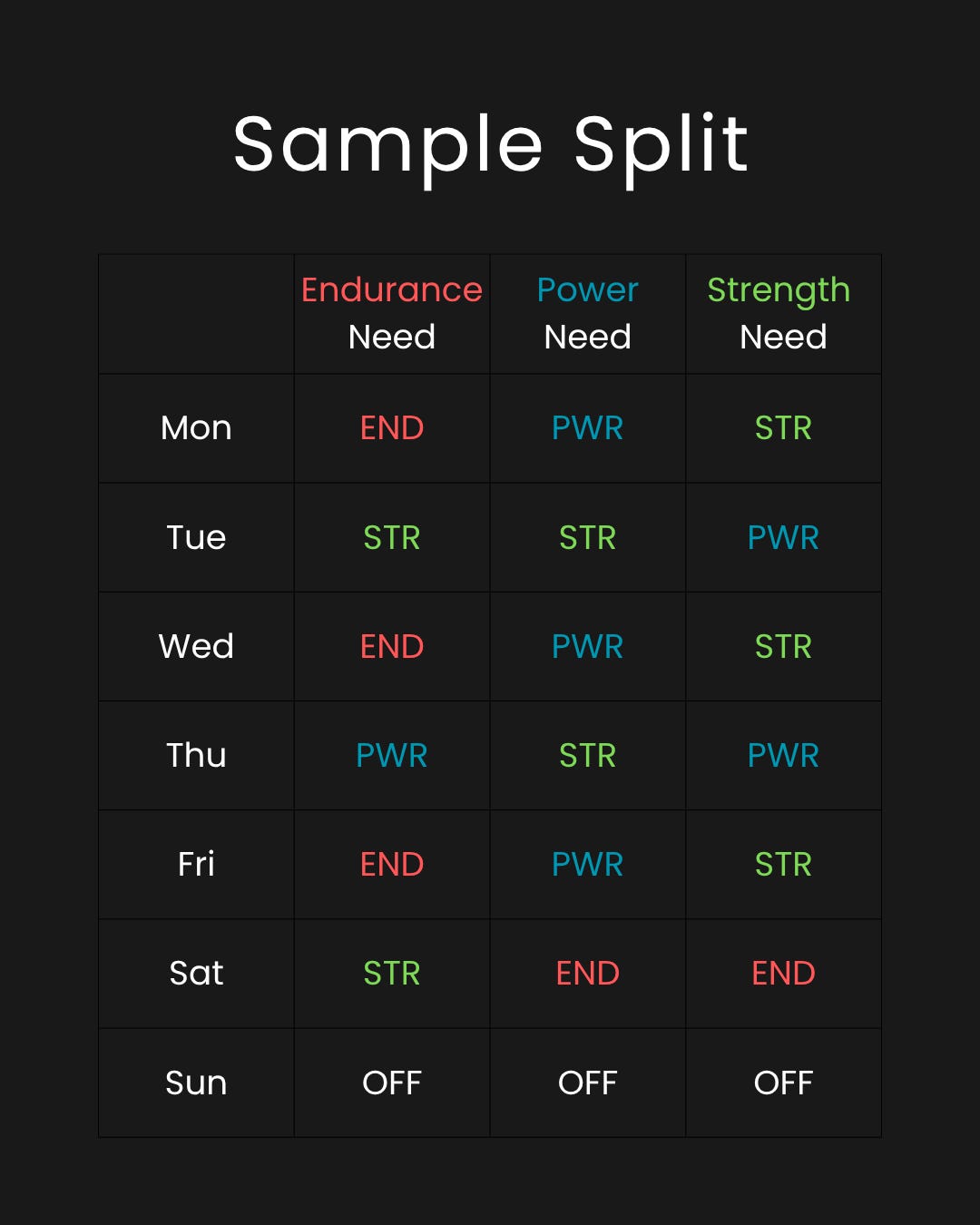
So, let’s make a weekly training structure that looks like:
3 session of what I need to train.
1 session of what I like to train.
1 session of what I want to maintain.
This can, of course, scale to 10 sessions per week, or 3. The idea is that the “like” days aren’t necessarily easy, but they keep morale high enough to dig deep on the “needs” days or to push through the melancholy of “maintain” days.
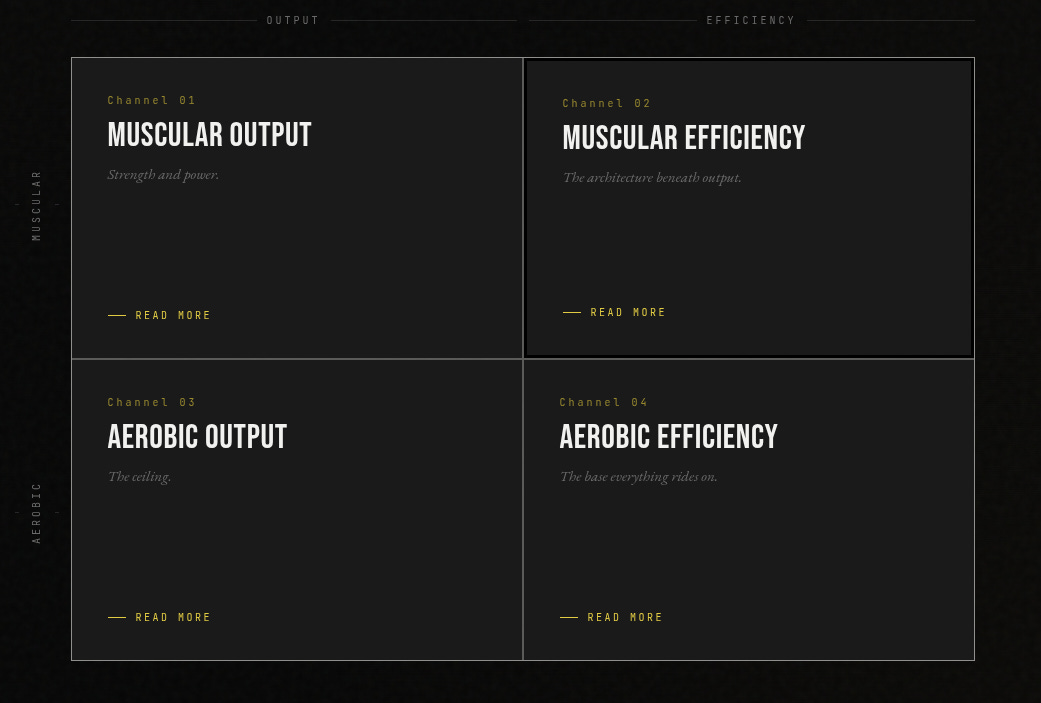
My colleagues at HeavyMeta have created an excellent webtool they describe as the Constraint Method. This helps us find what we “need” on a spectrum of:
Muscular vs. Aerobic systems.
Efficiency vs. Maximal output.
Step 3:
Taking things into your own hands.
Rollo May described depression as “the inability to conceive a future” and anxiety as “a call to create.” Without getting into social or political discourse, that’s a pretty good summary of the fitness industry as it exists today as well.
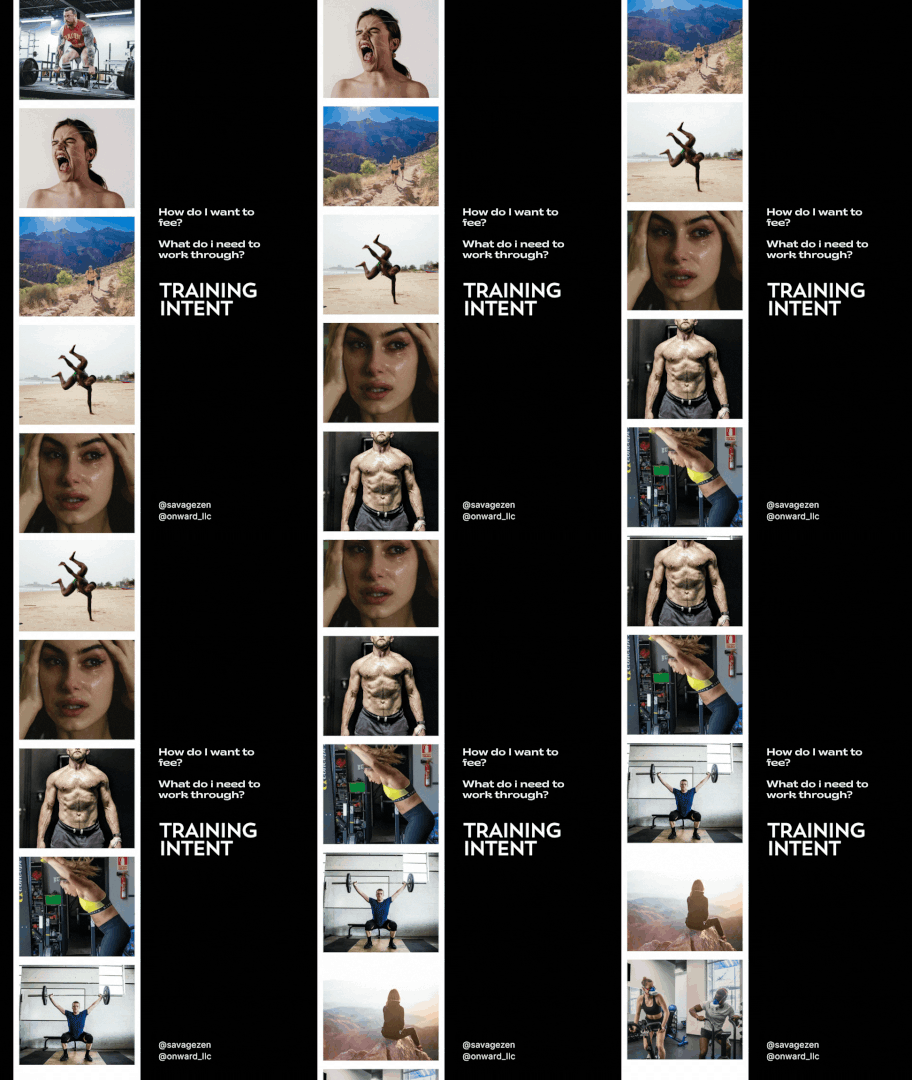
When I’m writing a training session, the first thing I want to address isn’t necessarily “what do I want to train”, but it’s analog of “how do I want to feel?”
In The Integrated Fitness Problem I mapped common training expressions onto their somatic experiences — at least as I understand them.
Endurance > Love
Mobility / Strength > Hope
Hypertrophy > Resilience
Power / Agility > Anger
Anaerobic Capacity > Valor
Aerobic Capacity > Anguish
Step 2 isn’t excluded here. We could just as well ask:
Which of these do I want to feel?
Which of these do I need to work with?
Other models like OPEX’s Energy System Training offer similar guidance:
Gains (power / velocity)
Pain (capacity / conditioning)
Sustain (endurance).
Pick one.
Step 4:
Making it specific.
Remember that “Law of Specificity” above? Now we need to answer the question:
What adaptation do I want to drive?
Options here include:
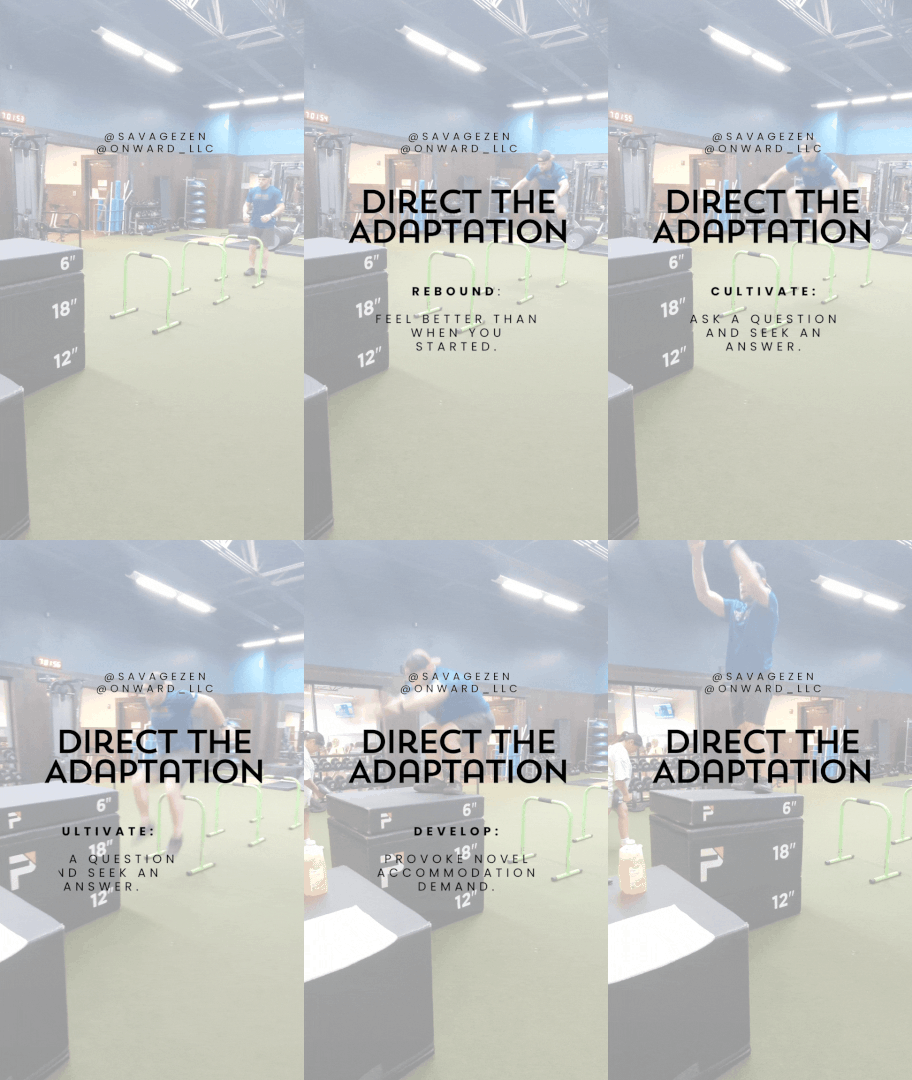
Rebound:
Beyond active recovery, there is an explicit intention here to feel better after the training session than when you start. Often times it takes a lot of work to learn how to not bury ourselves deeper and still get something out of our training.
Cultivate:
This is where I want to ask a question and seek an answer. Perhaps I want to “try things from the internet” or explore a new combination of movements either in a circuit or as a superset; or a familiar movement with an unfamiliar implement (e.g. sandbag); or I might put a breathing cadence or heart rate limit on the session.
Develop:
Here we are taking a known attribute or skill and pushing into novel territory that demands new accommodations from our body, mind, and spirit.
There is plenty of room in this entire blueprint for caveats, nuance, and of course one’s own subjectivity. In broader contexts I include the categories of:
Team
Test
Those require special design separate from regular individual training; the latter being a rare event with harsh consequences and uncompromising insight.
There isn’t enough space to cover all these topics in a single tool, but when looking at the options above, one should also consider how they map onto and are similar or different from:
Exercise
Play
Training
Practice
Step 5:
Adding structure to the intention.
So far we’ve created an “intended stimulus” and now need direction, a map. This can be done by deciding on a workout structure or session format.
The options here are limitless, but a few staples across “functional fitness” and elsewhere give us plenty to choose from.
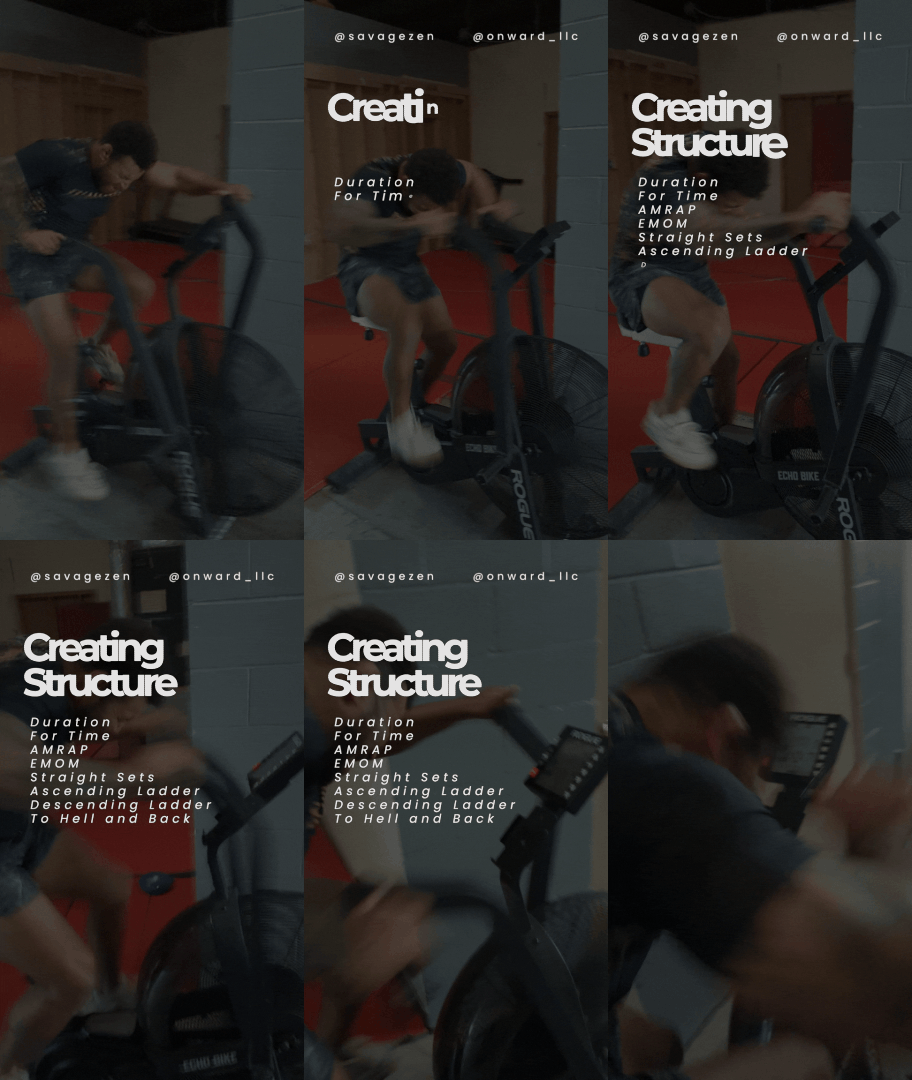
Duration:
Do X for Y minutes. Often this is an endurance stimulus and differs from ARMAPs and “For Time” (below) in intention. Duration sessions have the intention to increase difficulty by extending duration (volume) and not packing more work into a given duration or doing the same work faster (capacity).
For Time:
Do the prescribed (static) workload as fast as possible. Scored by time.
AMRAP:
As many reps / rounds as possible within the time frame. Noted as AMRAP/X — where X is the number of minutes. Scored by time.
EMOM:
Every minute on the minute do the prescribed work (e.g. bike x 10 calories, then 10 x burpees). Noted as EMOM/10 — where X is the total number of minutes. Scored by load.
Straight Sets:
Classic bodybuilding / powerlifting structures of Sets x Reps (e.g. 3 sets of 8 reps; 3 x 8). Scored by load. Scored by load.
Ladder (Ascending):
Ascending intervals of time / reps. (e.g. 10-20-30-40-50 reps of row-erg calories and ski-erg calories — 300 calories combined). Often used to teach pacing. Scored for time.
Ladder (Descending):
Descending intervals of time / reps. (e.g. 50-40-30-20-10 reps of burpees and 10m shuttle run). Often used to build momentum and intensity. Scored for time.
To Hell and Back:
A descending interval followed by an ascending interval. (e.g. 50-40-30-20-10-20-30-40-50 reps). Scored for time.
Step 6:
Selecting movements and warming up.
Step 5 gave some example movements along with suggested structures, but generally we’re selecting from a few categories:
Press (load moves away from body).
Pull (load moves towards body).
Hinge (hip driven movement).
Squat (knee driven movement).
Isometric (load is held and does not move, includes carries).
Plyometric (rate of force is dynamic).
Cardiovascular (heart and lungs are targeted).
Warming up is an art form all on its own and is greatly overlooked. Somewhat paradoxically, it should be difficult to tell where the warm up ends and where the “work” begins.
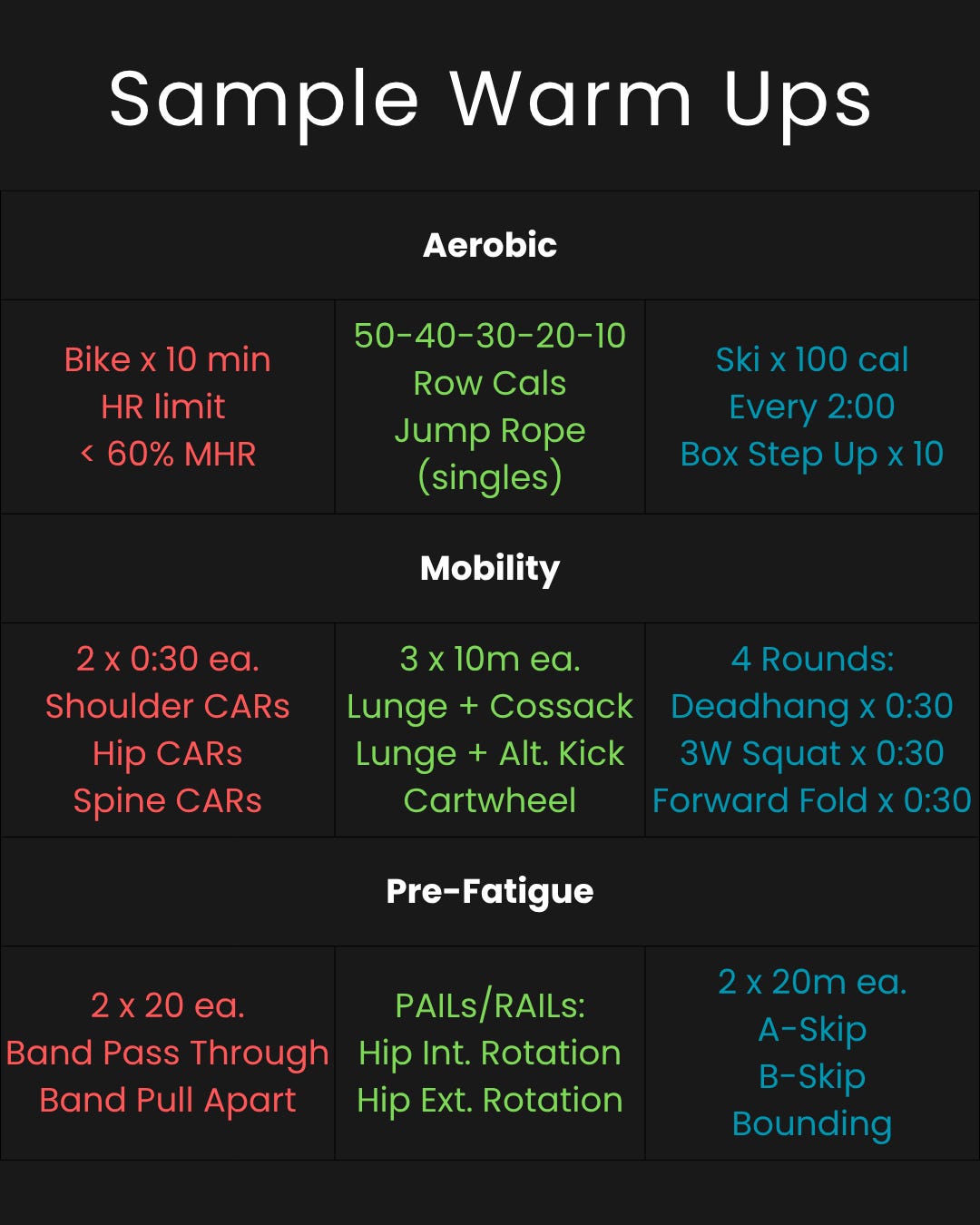
My general warm up template looks like this:
Aerobic:
The goal here is just to get blood flowing, break a sweat, and check in with ourselves.
Mobility:
Since you assessed yourself in the aerobic warm up, this is where you address the general weaknesses and limitations you have as well as those relevant to the “work” segment.
Primer / Pre-Fatigue:
Think about the working movements and intended stimulus you selected. We want to spend some time pre-fatiguing or “waking up” the musculature (red stuff) and connective tissue (white stuff) related to those aspects. This should generally resemble the work structure, but differ in volume and intensity.
Combined, and depending on the intended stimulus for the day, this warm up structure might take 15 minutes, or 30. It’s your job to determine which is most applicable.

Step 7:
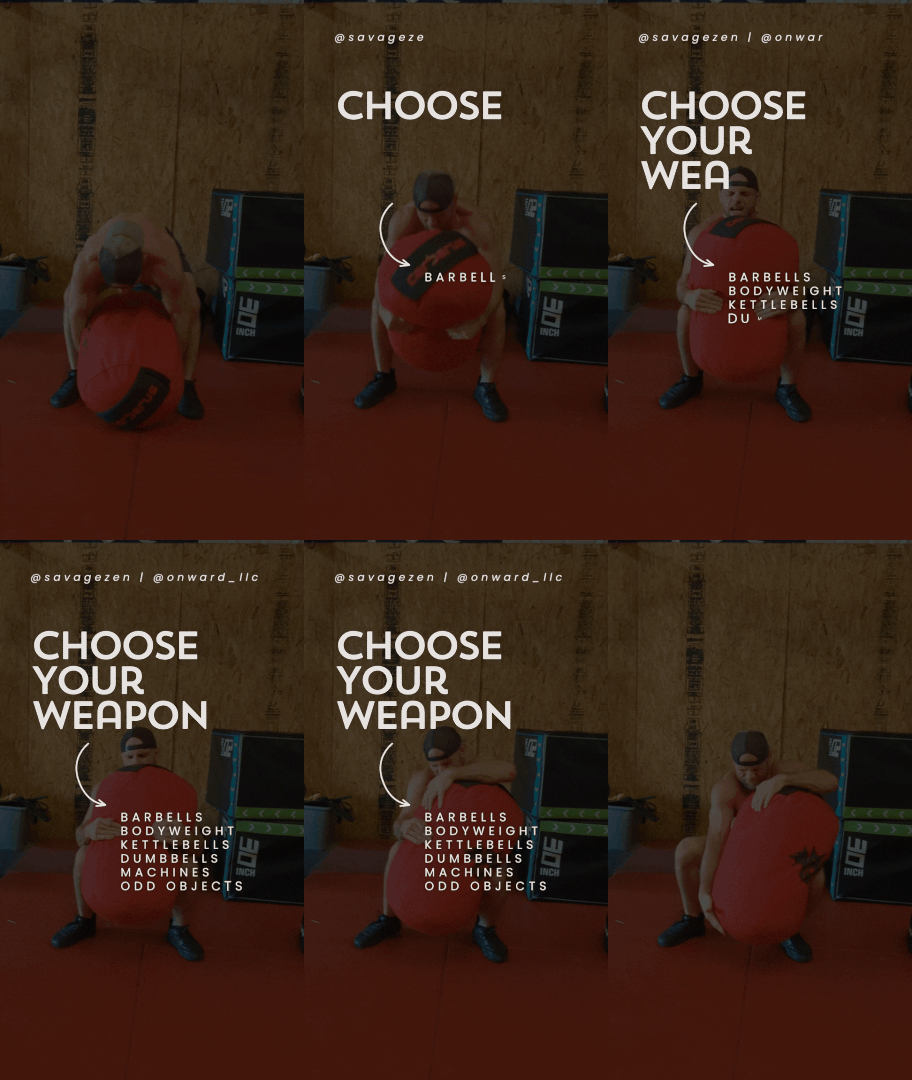
Choose the weapon (implement).
Reading is fundamental. So far I’ve only listed instructions. You should read them all first before acting. If you didn’t, and already did the warm up, go home for today. Again, this isn’t a personal indictment or value judgment. Its an honest evaluation, a signal that you need to pump the brakes and exercise a little more forethought.
Our tools (weapons / implements) are what we use to load the movements we selected. Similarly, this can get endlessly complicated, so for simplicity sake let’s keep the categories to:
Barbells
Dumbbells / Kettlebells
Bodyweight (includes ring / bar gymnastics)
Machines (ergs: bike, row, ski, run)
Odd Objects (sandbags, medballs, sleds, etc.)
Step 8:
Take action, observe, assess, adapt.
Vision boards and manifesting — in the pop-culture and pop-spirituality sense — are largely distractions, detrimental even. It’s easy to feel good looking at pictures and to “visualize” yourself on the podium. But, you still have to do the work to get there.
What’s more important is that we need to observe and reflect. That’s part of that taking action; lest we might as well just be doing random workouts from a hopper (*cough*).
What worked? What allowed it?
What didn’t work? What was the limiting factor?
What did I learn about myself?
Furthermore, our brains aren’t capable of consolidating new information (memory) — let alone complex movement patterns (like those in fighting or racket sports) — under states of high stimulation (or hypo stimulation if we’re getting really technical).
Trauma, in the broadest sense, and overstimulation shrink our cognitive capacities. Auditory and visual exclusion set in while executive functioning goes out the window.
Good coaches don’t try to give or solicit feedback while an athlete’s still gasping for air. There needs to be some kind of clear eyes and composure, lest we’re all just screaming into the fog of war.
So, don’t do that to yourself.
Take a minute, or five, to sink in and savor what you’ve created. Cooldowns are criminally underrated for this reason. They aren’t an excuse to cram in more junk volume. They’re an intentional practice to jump start the recovery process — which is to say adaptation to the stimulus we’ve invoked.
Once you’ve come “back to reality” take out a pen and notebook and answer the diagnostic questions above. Then, adapt the plan from Step 2 as necessary. Tomorrow, pick up Step 3 again.
Repeat until satisfied.
Epilogue:
As always, there is a time for broadening and deepening, hardening and sharpening. This isn’t just a metaphor for training intensity — where building breadth and “hardening” often leaves us dull, and constantly sharpening makes us brittle.
It is also a metaphor for understanding ourselves, and in this case, by way of physical training. Sales hooks all across the internet want to keep you locked into one, or simultaneously paying for several, subscription / services. Both miss the point.
If the blueprint above doesn’t produce desirable training results, you simply haven’t learned enough yet. Go pay someone to learn from — a coach, a program, a new sport, whatever. Don’t half ass it. Go all in until it stops working.
Then, unplug.
Engage in a “test your understanding” phase of training and write your own program of the same investment — 3, 6, or 12 months. Then evaluate where you need help and repeat the cycle.
This is what real “GPP” (General Physical Preparedness) looks like. It means alleviating constraints and raising the bar for limiting factors. It does not mean training all or “general” attributes evenly across a normal distribution.
Eventually, there will come a time, function, and desire for specialization. At that point we need to recognize that weeds will grow regardless, so make sure to water the flowers.
One last things to consider is how we measure progress, or at least make sure we’re going in the right direction — a compass. My personal training log or long term overview that I update each month only notes simple conditions and their outcomes:
Month
Weekly Training Split (including my fitness-focus and bjj-focus)
Percent Body Fat
5K Best (that month)
HRV (monthly average)
These could be anything you want, but the general idea is that I want to make sure I’m managing allostatic load (HRV), maintaining an aerobic base (5K), and keeping body composition reasonable (fat percentage).
I’d love to tell you that PRs and numbers on the stopwatch or barbell are the best markers of progress. But, if you’re reading this, you’re probably not a novice anymore, and you know that if those are the only things you measure success by, you’re going to be sorely disappointed — and / or meet a short end.
Before Terry Brands won an Olympic bronze medal in wrestling in 2000, his coach, the legendary Dan Gable, told him (paraphrased):
“You can’t go hard with the young guys every day anymore. What you gotta do is only do things that make you feel really good, so that when you feel really good you can train really hard.”
Looking for a guided and personalized approach to your fitness training that builds a better vessel for achieving physical outcomes?
Or stay up to date for free with the Savage Zen Athletics Newsletter!
Updated: 2026.11.15