

I haven’t done an article about grappling in a while, and the ADCC World Championship is about as big as it gets. So, only happening once every two years, it always seems ripe for analysis of trends in the sport.
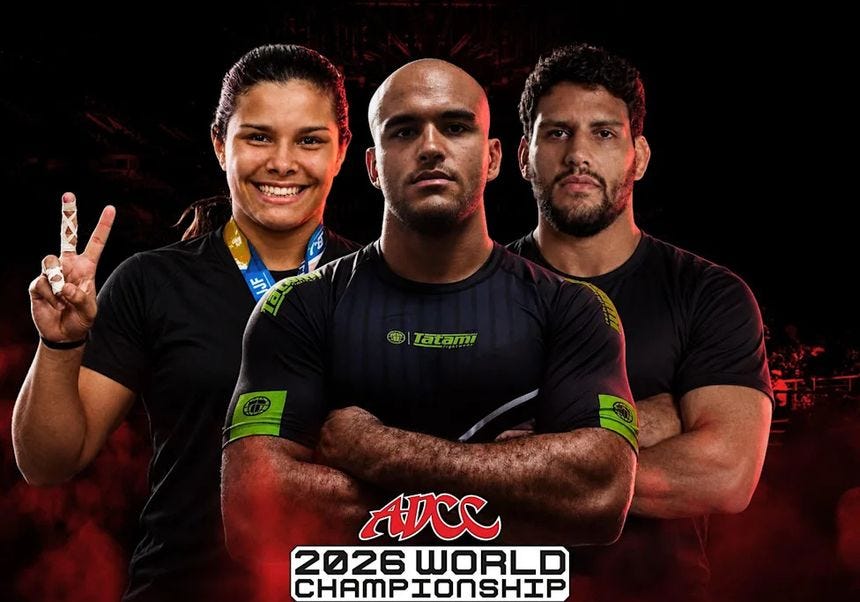
Part of the excitement of an “Olympic” event like this is that you can’t keep up with all of the action all at once. Thankfully, one of the things Flograppling has gotten right is the “Flo Zone” which lets you watch three matches at the same time.
Naturally, like most folks I usually watch the whole event all the way through for entertainment first, then go back and replay / study individual matches as needed. However, I did have the foresight to keep a spreadsheet of win methods, submissions, and point spreads so that I could push some quick data to Notes as soon as the event was over.
Here, I want to dig a little deeper into those numbers as well as take a high level perspective of what I observed from the event, and maybe make a few predictions.
By the Numbers:
First, for the nerds, which are most of us, let’s look at some high level data.
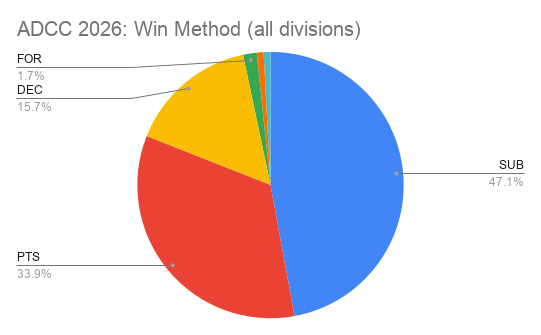
Off the cuff I thought there were a lot more submissions than usual. I’m not sure how this compares to previous years, but almost half (47%) of all matches across all divisions in this event ended by submission.
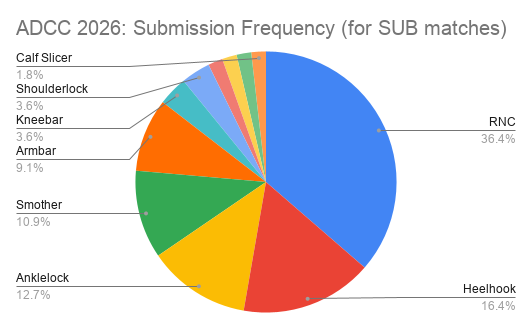
As you’d expect, for matches that ended by submission, 36% of those submissions were rear naked chokes, followed by heelhooks at 16%. While the RNC is always the clear favorite, typically we see heelhooks and armbars flip flopping for the second and third spot, with some combination of armbars, triangles (including rear triangles), and anklelocks rounding out the top five.
This year, anklelocks pushed to a solid third place (something I’ll talk more about below) and surprisingly there were enough smother “chokes” to contend with armbars and place that submission in the top five as well.
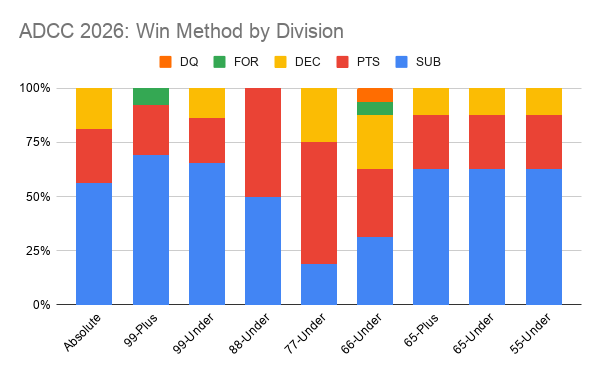
As far as division-specific data goes, it was a lot harder to submit smaller men (66, 77, and 88 Kg divisions). If we only include the male divisions, the data isn’t clear on matches won by decision. But, including data from female divisions, we clearly see that there are more matches won by decision in lighter divisions (-77, -66, +65, -65, -55) compared to heavier divisions (-88, -99, +99, absolute).
Note as well that there are only half as many female competitors in each division and only three female divisions overall (compared to 6 male divisions), so a couple outcomes one way or the other have a larger impact on the overall data.

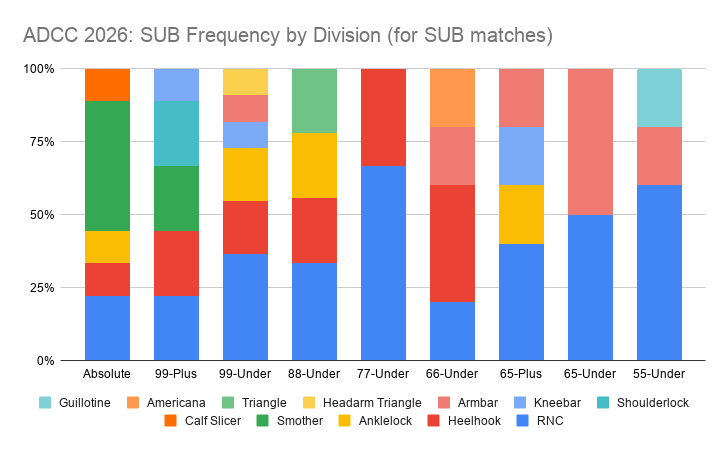
Now, the really fun part, which submissions were most frequent in each division? Here again, recall that not all divisions had the same number of submission finishes, so the data can be a little skewed.
At any rate, we already know that RNCs are the favorite across the board. Further, we didn’t need a fancy graph to know — though it’s still fun to see — that heavyweights like to smother (and head-arm triangle) while smaller guys attack the legs and chicks dig armbars.
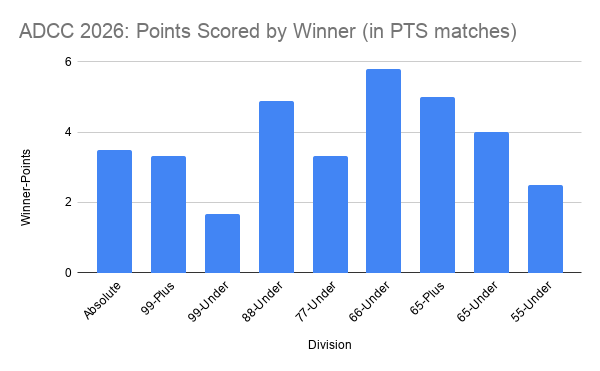
Something else I was interested in was point spread. It’s been well established many times that the first person to score has a significant statistical advantage for winning the match.
I did not look this deep, yet, but the effect is so strong, that if you achieve a scoring position before the points period (the first half of the match), you may actually hurt your (statistical) chances of winning. Though, setting an early pace while building momentum and confidence are considerable factors as well.
The average number of points scored by any player in all matches was 1.1 (including penalties since they’re a “true negative”). There were only three matches where the loser scored positive points. About 2/3 of matches won by points had a 1-3 point spread.
All of that confirms what most of us already know, that it’s hard to score under ADCC rules. Further, if you score 1 point, you had an 87% chance of winning. If you scored 4 or more points, that went to 100%. However, note that per ADCC rules you’re only able to score points in the second half of the match, so the time required to score more than 4 points is a significant limiting factor.
Now that we know ~1 point is a notable margin, and 4 points is huge, let’s recall that 21% of matches in the -99, +99, and Absolute divisions (average) were won by points. The average scored by the winner? 2.83.
When you compare that to all other divisions (average), 35% of matches were won by points and the winner scored an average of 4.25. Again, this isn’t really new information, but for the big guys, scoring first (or at all) has more significant consequences.
For medium and small guys, and all women, this means that you need to score more points in order to achieve the same margin for victory.

The Big Picture:
Now, let’s zoom out and take a look at some high level observations.
Ankle Locks:
As mentioned, anklelocks have made a triumphant return. Actually, they never left, people just got better at defending heelhooks, which have actually risen back to a solid second place as well.
Hungry Newcomers:
I was skeptical of this event at first as only a few reigning champions were returning and there were many notable omissions and invitations declined from premiere competitors — no Ryans, Rodriguezs, Ruotolos, or Tacketts, etc.
However, I was quickly reminded that winning or placing at trials is no small task. People showed up either with momentum or a chip on their shoulder, and that made for good matches!
In a lot of ways this did feel like a turning of the tide with so many omissions on top of OGs either retiring, not making it to the second day, or getting upset.
No Redemption:
With a single, technical, exception (Hugo v. Saunders) nobody that got down on points (including penalties) came back to win by submission. In fact, they didn’t come back to win period.
Drama as a Feature:
Jiu Jitsu started with family. Where there is family, there will always be drama. Some folks are (still) entitle divas. Some have a reputation for starting shit off the mat. Some have dance-offs with each other after the match. That’s just how it goes sometimes.
Stay Tuned for Part 2!
In Part 2 I’ll look at some of the standout athletes and matches as well as high-level perspectives for the sport / event in general. This will also include some wishful thinking and predictions for future events!
I wonder who the most overrated and underrated player is and if there are any mispriced odds in the prediction markets.