

“We set the tone and start the work for the upcoming year instead of wallowing in a hangover and bad sleep on day one. This isn’t a resolution; this is how we practice.”

It’s been a few years since I’ve taken on this kind of endeavor, but 6-hours of continuous effort is known to stick with a man. It takes time to savor, comprehend, and digest that kind of offering. In truth, I don’t really know if I’m capable of such an investment once per year.
It’s not so much the physical impact — though that alone is quite substantial when you’re cooking 3x BMR in a day — it’s the potency of your awareness that takes time to re-calibrate.
I’ve done hard days. I’ve done long days. I’ve done session that my legs need 4 or 5 days after to feel normal again. Some of those sessions were just about the suffering. Some were because life required more of me outside training.
A few of those sessions, the really good ones, left a strong enough imprint that I don’t need (or particularly want) to do them again — at least not until that lesson starts to fade.

This year’s Space Race (from Ollin) is an accumulative knockout.
There is a 5-hour total time limit for the event.
Teams of 2.
There are 4 heats or evolutions that can be completed in any order, but all 4 must be completed before attempting the final scored event.
The final event is a team “death by” structure.
If you fail one of the first four event you must repeat it until you pass before “earning” the right to attempt the final scored event. For some events (that take ~60 minutes) this is an irrecoverable mistake.
Let’s take a look how it panned out!
Stage 1: Distance
2 miles running, 1 mile farmer carry @ 2x20kg, 1 mile bear crawl (Split however you like between partners).
Austin / Tanner (each):
1 mile run
1/2 mile farmer carry at 2 x 45#
1/2 mile bear crawl
Total Time: 1:08:11
Stage 2: Fortitude
30-min Sandbag Hold @ 50% of average team Body Weight (Front Carry position). Effort can be shared, but if the bag drops, the timer starts over at 0.
We didn’t have a sandbag so substituted for a Zercher hold at 95# (50% average bodyweight). Technically we did rack the bar for a couple seconds when switching off, but we agreed to add a few penalty minutes, and that handing off a bar in this position would be (possible, but) unnecessarily contrived.
Stage 3: Capacity
Sub 7-min (Men) 2km Row/Ski OR 4km Bike Erg (Only one partner needs to complete, but both can contribute). This can be performed as part of another effort, like the 2000 reps challenge.
8 x 250m row: 7:00 total.
Stage 4: Volume
1,000 reps each (2,000 total) completed within 1 hour. Movements: Machine cals (any machine), lunges, step-ups, push-ups, squats, sit-ups. Partition as you see fit, but 2000 reps must be acquired within the 60-minute window, and each exercise must be done at least once. A stronger partner may help the other ie; one partner could get 1200, making the remaining needed 800 reps. If you would like to run to sub a machine, every 400m is 40cals.
My personal rep count was:
Bike Calories: 1
Box Step Up (20”): 1 (each side)
Lunge: 170 (each side)
Push Up: 570
Sit Up: 210
Stage 5: Final Event
Task: Team effort for Max Calories Ski Erg.
The Kicker: “Death by Air Squat” starts at the 10-minute mark. You may accumulate calories as long as the required squats are performed within the minute.
We actually misread the instructions and started the death-by squats right away. Technically, this meant we could have added 10-minutes of skiing prior to that. However, here are our results as performed:
Ski Calories (Tanner): 405 calories (31:00)
Air Squats (Austin): 526 (out on round of 32)
Assessment:
Some things we did really well were:
Strategize before beginning (it’s not wise to wing something like this).
Use the first hour (distance block) as a warm up since it’s not a timed event.
Regroup after each block (hydrate, snack, re-evaluate tactics).
Communicate on the fly (who needs help where, how’s our overall pace, how you holding up?).
Cash out by trusting Tanner’s lungs and my quads.
Basically, we let each person do what they were good at, strategize without overcomplicating structures, and adapt as needed. If you’re not familiar with competitive team-style workouts, this is what makes them really cool and great bonding experiences.
Tanner was better aerobically, so that helped during the volume and bear crawls where my stiff hips dumped a ton of weight forward into my shoulders. I was better at the Zercher holds, and caught up once I figured out the volume cadence.
We finished the fourth block around 3:15:00 so there was plenty of time to rest, but eventually we started to cool of and soreness started to set in so it was time to shit or get off the pot for the final event.
Fuel was appropriate as well. Tanner “carb loaded” the day before, I didn’t. The pre-game meal was hashbrowns, bacon, and eggs for both. Electrolytes for both of us during. Tanner opted for kiwi and candy during while I hit a bottle of maple syrup. All of that seemed fine.
What’s unique about this sort of battery compared to say a single event like a marathon or 6-hour AMRAP is that there’s a ton of useful data that can come out of it as far as what you (and / or your partner) are and aren’t good at.
Let’s take a look at some of that:
Tactics: We probably should have done the capacity (bike/row/ski sprints) right after the “warm up” since the sandbag/Zercher holds would fatigue similar muscle groups as the rowing we chose.
Technique: We decided on the rower for the capacity block since the bike was a longer distance and we were going to ski later. However, neither of us row a ton so our technique was sloppy. By contrast, the bike would be a longer distance, but would have better efficiency of movement — power straight to the pedals instead of butt sliding all over the rower seat.
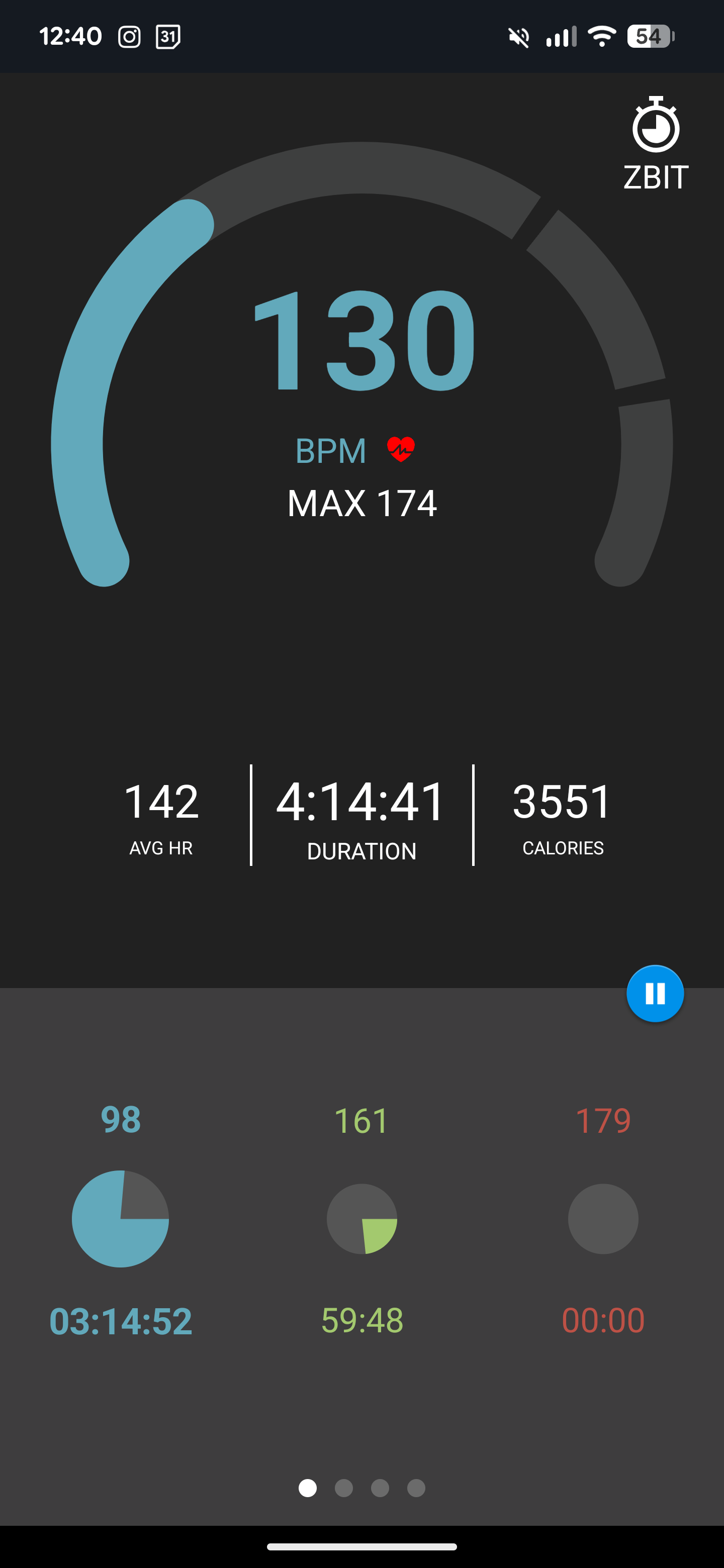
We just barely made pace, but this event, being only 7 minutes would have been easier to rest, re-evaluate, and make up if needed. I did notice that on my heart rate monitor I was close, but never quite broke into my red zone (MHR was 174). That data is congruent with the above technical observations — it’s not like I wasn’t trying and wanted to just barely skate by.
Mobility: Not surprisingly, my hips have issues. As mentioned above this cause the heels of my hands to get pounded during the bear crawls; and the hardest part of the squats wasn’t the quad pump, but punching my hip/flexors below parallel.
Capacity: Both Tanner and I roll, a lot. Our “work capacity” is highly specialized towards grappling. As such, we probably don’t train it enough in a pure fitness environment.
Endurance: Not surprisingly, it showed that this is where I spend the least time training. However, I have to say that while I was slow (e.g. running) I wasn’t (relatively more) miserable or too far behind on the bear crawls or 1,000 reps.
Aftermath:
Looking around as we progressed through the events, no one knew what was going on, but some people were taking note. We weren’t particularly looking for recognition because few people in a globo-gym would understand. Plus, we wanted food more than we wanted to explain in that particular moment.
Humorously, I recall saying “my legs don’t hurt that bad” in the locker room and then literally falling out of my truck at the pub because they had turned to Jell-O after sitting down for 10 minutes.
When I got home, stoked a bonfire and cracked a few more cold ones to take things in. Eventually, the hedonistic pleasure of burgers, beer, and ice cream started to wear off. A bone-deep ache in my muscles began to set in. This will suck in the morning, but I don’t regret doing the work today.
You’re not better than anyone else because you did something hard — no matter how few people will ever achieve or even attempt it. You’re better because the you of yesterday had not done these things, plumbed these depths, that you have scoured with honesty today.
The Integrated Fitness Problem

I’ve created a 12-module / 12-month program to develop general physical preparedness (GPP) and grappling (BJJ) specific conditioning in two separate phases. This isn’t just another PDF fitness program or 30-day or 90-day challenge. This is a call-to-action for you to invest in choosing your own adventure. It’s an invitation to move how you feel and feel how you move. The overlap between our physical and emotional states has a lot to teach us about how we move outwardly and feel inwardly.
I went 1)Capacity 2)Volume 3)Fortitude 4)Distance 5) Final Stage