

The CrossFit continuum of health, leading us from sickness to wellness to fitness, leaves a lot to be desired. Obviously, the term “fitness” implies a question of what one is actually “fit” for. Additionally, we may consider a “healthy” state as being “fit for survival and reproduction.”
I’ve taken a lot heat in the “functional” health / fitness space for clapping back that “food is fuel, not medicine.” I’d say the same for locomotion. More and more evidence is emerging to show that it is not so much the case that exercise is an anti-depressant, but that being sedentary is an active depressant.
In short, motion is a human’s natural state. However, these terms — movement, exercise, training — often get used interchangeably when in reality they have distinct functions and implications as to who we are while practicing them.

First, I want to be clear, that in a lot of recent posts it may seem like I’m ragging on CrossFit, but that’s not the case. A lot of these ideas, like the hierarchy of development, are quite good. They’re just 20 years old and need some context added — lest we’ve spent those 20 years learning nothing.
Conceptually, the move from:
Sickness » Wellness » Fitness
Is really to say we’re moving from:
Deficiency » Sufficiency » Proficiency
Virtually anyone who has taken any interest in their health or fitness will tell you that modern (American) medicine has quite the disparity between what kind of “recommended daily allowance” will keep you non-deficient versus what is actually sufficient for the goal or end you are seeking.

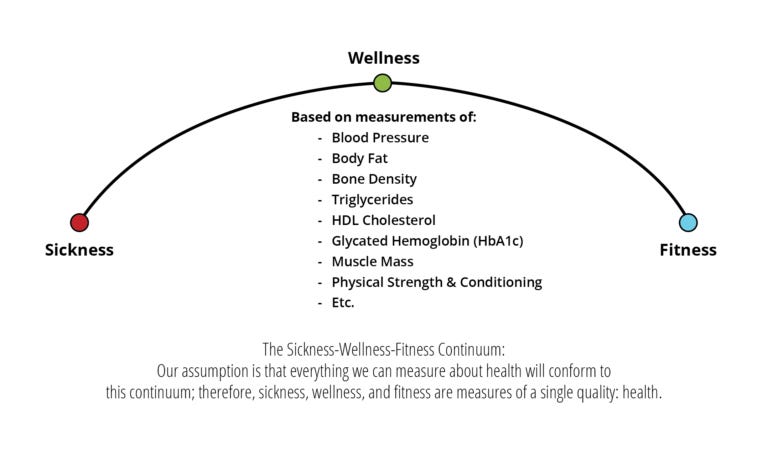
I’m inclined to point out that the above arc does not account for the quite broad term of “performance.” Why stop at proficiency (fitness) when you can achieve excellence (performance)?
Certainly, fitness, or the lack thereof, can be a limiting factor in our ability to express “performance” — however that may be defined. Excessive emphasis on always performing leads us paradoxically struggling to maintain wellness and even non-sickness (i.e. injury).
All the “optimal-bros” online would do well to recall that such events are, by definition, not sustainable. An indefinite “peak” is called a “plateau.”
We can actually do much worse than sickness by becoming decrepit — defined more by our dysfunction than capability. Many are preening online about removing anything we “don’t need” for biological survival; under the premise that those things then carry unworthy risk.
Therein lies the problem with this conservative thinking. Your biological survival is, in fact, not necessary at all — let alone cell phones, air conditioning, automobiles, or sports. So, my paramount question is, what are we doing in the meantime?
Would you like to wear out or rust out before you inevitably expire? What is the point of living forever if you have no stories worth telling? Meanwhile, let’s also make sure we persist long enough to laugh about how stupid and lucky we were to have survived!
Movement:
As mentioned above, and many times before, avoidance is a terrible plague. You will never win by trying to not lose. Ultimately, “risk aversion” (i.e. litigation aversion) has largely prompted medical and “sport science” advice in this direction.
It hurts to squat, stop it.
You sprained your ankle playing basketball, stop it.
God forbid your hips, ankles, and knees need to bend more than 90’ to pick something up off the floor; and if you press the “longevity experts” you better give up all hope of a PR after 40. Maybe just sign up for the nursing home now.
Paradoxically, the same types of locomotion we must all learn as infants, toddlers, and children are exactly the same patterns that keep the elderly lively.
Crawl
Walk
Carry
Jump
Climb
Tumble
You might not need to “balance what you eat, drink, and do” nearly as much as you need to “play like a 5-year old”, but eat like an adult and drink more water (instead of other stuff).
Exercise:
Whereas “movement” is simply about different planes of locomotion, exercise requires exertion… effort. I used to look pejoratively on this as directionless exhaustion. Certainly that is often the case in many “boot/y camp” types of group fitness classes.
However, I’ve changed my mind to view this as an important part of the process. The goal is to move something within us, out of us.
EX-ercise (in multiple contexts).
EX-ert.
EX-pell.
These words all share the same root.
In a technical sense, we might refer to this as “active recovery” — the active and intentional engagement in activity that helps remove waste, repair tissue, and does not further incur more CNS stress and fatigue.
Our tolerance for adaptation is limited, no matter how much we train or grow it. Thus, we must inevitably take out the trash. We have to clear space psychically, neurologically, and muscularly in order to be able to budget for further stimulus — which is the pre-requisite for adaptation (i.e. progress).
Training:
When it comes to training, our exertion now requires intention and direction (among other things). Laws of specificity and adaptation abound, as well as concepts of (progressive) overload.
While effort (and its rate of perception, e.g. RPE) is applicable for the above “exercise” domain, it is not relevant for training.
Effort does not equal outcomes. Though, the outcomes we’re training for will require effort.
You can dig yourself into all kinds of holes, to various depths, and still miss the target. It feels hard. You moved. You exerted yourself. You achieved little else.
Our ability to train in a developmentally productive way will vary greatly depending on our “training age.” That refers to the amount of our genetic potential that has been actualized. This takes chronological time, intention, novel stimulation, and adequate recovery to produce desirable adaptations.
Inevitably, this follows a j-shape curve wherein initially we see quick gains seemingly just by showing up. However, there is a growing disproportionate return on investment where more time, effort, and specificity (and sometimes remedial generality and “fitness” to maintain our “wellness”) are required to provide smaller and smaller increments of improvement.
Practice:
This is another one that I used to dismiss as “re-training” on the surface, but it’s quite important for athletic development. Again, language matters. Virtually all team / ball sports call their daily activities “practice”; which is to say they are re-training and re-enforcing previously learned skills.
Ironically, this is a far cry from what we often see in many other sports:
Just run more (running).
Just spar more (combat sports).
Just add weight (lifting).
Just do the WOD.
As if to say that progress and success in those fields are just random occurrences you need to hit the right slot machine on. Most of those things I just mentioned are Olympic sports.
Running is a skill.
Weightlifting is a skill.
Every combat sport is built on skills.
CrossFit requires specific skills training to build general physical attributes.
Thus, we do need to practice those skills.
Adaptation does not wait for your intention or activity. Skills are depreciable assets. If you’re not using them, you’re losing them.
Conclusion:
Coming full circle then, our state of wellness, fitness, or performance is not passively sustained. We are either growing or atrophying. As discussed earlier, perpetual excellence is a mistaken impossibility.
The nature of the universe is towards entropy in the sense that it simply costs less energy.
Thus, if we wish to not go quietly, we have to fight to maintain our fitness. Do not accept mediocrity, wellness, or non-sickness. You must choose where and when you’d like to perform, what it will cost you, and what is “well-enough” left alone.
For example, let’s consider how pervasive modern technology — specifically wearable technology — has become in our lives, and particularly in the fitness industry.
I have a fancy Garmin watch. All of the “smart features” are turned off. I’ve never made one phone call, sent one text message, or issued a single voice command from it. The “face” has the time, date, and a seconds counter. The most used “app” is the countdown timer.
It logs biometric and workout data in the background. The numbers are not the objective. I care not for someone else’s synthetic and proprietary benchmarks — “fitness age”, “step count streak”, “badges”, etc.
Those little dopamine and accountability hits have a purpose. They may keep you engaged and moving, and for that they are fine. They may even help you exert yourself a little further, a little more often, or more intentionally.
They will never teach you the intuition needed to expel what’s cluttering your life or impeding your training and making your skill retention lag. What they do offer in terms of qualitative “practice” evaluation is limited to activities easily monitored by a GPS radio and proprietary algorithm.
You are the system and the signal. Learn to listen.
The Integrated Fitness Problem [v1.0]
![The Integrated Fitness Problem [v1.0]](https://substackcdn.com/image/fetch/$s_!jLBX!,w_280,h_280,c_fill,f_webp,q_auto:good,fl_progressive:steep,g_auto/https%3A%2F%2Fsubstack-post-media.s3.amazonaws.com%2Fpublic%2Fimages%2F222dc620-af54-4649-92fb-720ba44f9c06_922x922.webp)
The fitness industry is broken. It cannot escape that it is part of a world where seemingly everything is a performative anesthetic, science is “settled”, and we are inundated with plagues of pop-spirituality.
My end goal (for fitness as well as finances) -- if someone I like invites me to do something that I want to do, I can answer in one word "yes" without any hesitation that I can if I want.
"Want to hike up Kili and hike around Tanzania?"
"Want to do Eiger UTMB ultra?
"I've never done a 1/2 marathon before and have one tomorrow; want to pace me?"
"Want to ski Vinson Massif?"
Real recent ones. Just answered "yes" then did. I'm not that social, don't propose too much, maybe 1-2 epic adventures/year but always am ready for more if it is someone good in the woods. Shoot/lift/run/roll... either you're ready or not. If you come up with some excuse or miss the boat because you need more preparation, then you start to get off tempo with people who are hitting it hard. If you can just say "yes" with the skills/strength/time/money to grab a 45L pack and walk out the door to any of 7 continent whenever you want, then you can keep learning and getting better by doing stuff. The gym has to be for something. Indoors is for outdoors.
And whoever you're dating: be able to toss her over your shoulder and sprint down a few flights of steps if the building catches fire (or if you just feel like it). It might be necessary. It might be fun. If you can't there are two ways to solve it but getting strong safer than suggesting the other solution.