

Building autonomous, sensitive, and intuitive athletes is what this program was built for. While AI can easily churn out endless training programs with the most “evidence based” reps and sets, it will always fail to capture the human element that I have tried to illuminate in every module so far.

Learning to do something for yourself is a huge step. Learning to think for yourself and resist the urge to mimic or copy, even more or less “correct” ideas and patterns, is a victory on another level.
It has been the explicit intent of this program to avoid “expert creep.” No module is intended to make you “elite” or “optimal” at any given energy system expression. The modules are intended to give you a sampling so that your palette can become acquainted with the experiences each movement exposes you to.
The more well rounded an athlete is, the more they can get away with minimalist implementations or “greasing the groove” as Pavel called it. On the other hand, the more glaring our deficits (mobility or endurance for example) the more you’re going to need to explicitly dedicate entire training sessions to developing those attributes.
That leads us to a good discussion about training, programming, and investing. If you prepare 12-weeks for an endurance or strength event (for example), it is not “just another training session” regardless of what many internet sport psychologists will tell you.
The atmosphere is often entirely different — stages, judges, spectators, weather, expectations, consequences, etc. You don’t get to come back on Monday and try again. You have 12 weeks of exclusion from your family and dedication to your craft riding on this event.
In this module we have a chance to further explore curiosities and / or face challenges.
All of the modules we’ve covered so far deserve far more attention than the minimal 4-week buy-in we’ve given them. In truth, 12-weeks for each wouldn’t be a stretch. Tissue remodeling and ventilatory threshold adaptations take place over months, not single sessions.
This doesn’t mean you can’t make “progress” in a shorter time, but it does mean that adaptations that come on easy also leave just as easily. Typically, it takes 5-10 years of “regular, focused, and dedicated” training to reach your maximum adaptation potential.
That’s a fancy way of saying, “If, after 5 years, someone who would know, hasn’t told you (honestly) that you’re world caliber, you probably don’t have it in you.”
That doesn’t mean you can’t still improve. It doesn’t mean you can’t still get a lifetime of enjoyment out of an activity.
It means that if your training focus flip-flops every month it’s going to be hard to gain traction in any one direction; and rather than a lifetime of accumulation, you have a collection of random events.
It means that if you look back on your training from 3 or 5 years ago and nothing has changed, you’re either stuck or still just skimming the surface.
The above template is relevant for a well rounded athlete on a 10-day training cycle — 10 days “on, 2 days “off”. We can similarly scale this to 6 days on, 1 day off though the distribution gets a little contrived and there’s no inherent benefit to being obliged to a 7-day calendar week. Overall though, we’re looking for ~80% dosage of training frequency.
What’s important to note for the general athlete is that they’re still abiding by general principles and a hierarchy of energy systems. Conveniently, these also tend to mirror common prescriptions for heart rate “zones.”
At the lowest, most foundational tier, is our ability to move well. Recall that mobility isn’t a whimsical, passive session. It’s an active engagement in range of strength, and an exercise in hope.
Technically, while we need to breathe to move, mobility limitations often impose further limitations on “engine” expression — various implementations that might be used to develop endurance.
Our ability to breath and move thus gives us the tools to build resilience, tissue mass, and strength endurance — hypertrophy. Then, because of it’s potent signaling, capacity and power work have limited frequency.
Note as well that “desire” is not to be undervalued. Ultimately our Earth-time is short. If we’re not enjoying our training at least half the time, why are we doing it? Essentially we’re all just playing a game anyway.
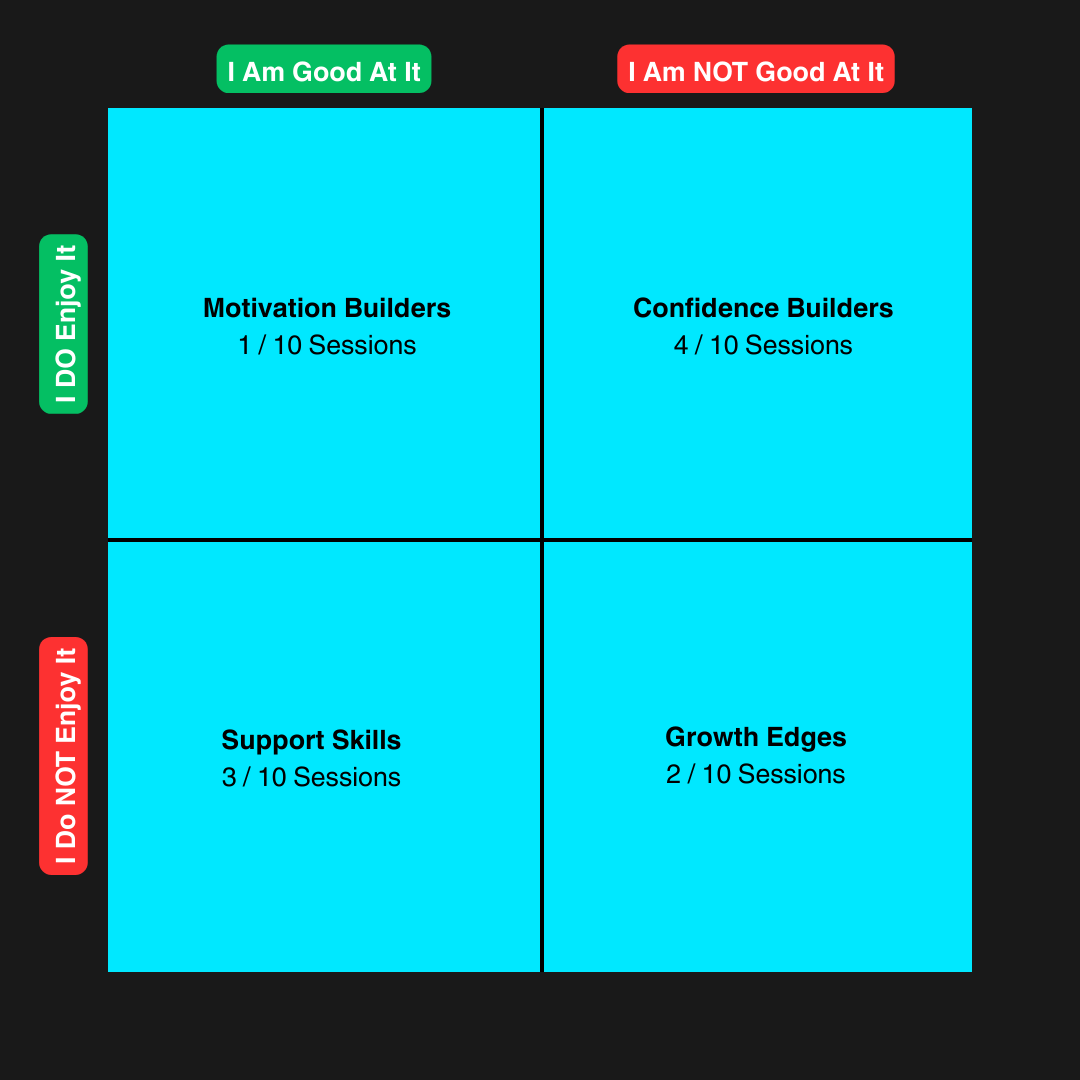
However, your individual training should reflect your individual needs. A simple 2x2 matrix can help us decide which attributes or energy systems need the most work or what we should focus on for our current training block (4-12 weeks).
Movements that we are good at and we enjoy (motivation builders) are good choices for active recovery days, or “shakeouts” when we’re “not feeling it.”
By contrast, areas that we do not enjoy and are not good at are where we need to spent most of our adaptation energy (growth edges). This isn’t necessarily dictated by number of training sessions, but the effort required to engage at a level that will develop meaningful adaptation.
To balance out this intense effort, cultivation and curiosity (medium intensity, confidence builders) days can be used as confidence builders by using movements and systems we’re not particularly good at, but generally enjoy engaging in.
Lastly, there may be a few movements and systems that we’re good at, but don’t particularly like or feel like drudgery. These “support skills” are good fillers for pre-fatigue and cool-downs.
Linear periodization looks great on a calendar and in textbooks. However, it’s a largely outdated modality because for most people, even competitive amateurs and professionals, the reality of our lives and complexities of stressors that affect adaptation contain inherent randomization.
The doesn’t mean we shouldn’t plan or focus. It means that “general physical preparedness” means that I am generally and equally capable in a broad range of physical domains. The natural outgrowth from there is to be “cross trained” in these sense that I am capable and prepared for randomization and mixed-modal training.
As that progression continues, well programmed training, even if randomized in disciplines, should expose different “general deficits.” As we become better conditioned to varied stressors and stimulus, we likely find that our anatomy, psychology, training, temperament, and culture lends us towards certain areas of specialization where we can continue training.
Training Sample Sessions

The least in important part of my integrated training modules are the literal reps and sets. However, they are the main language used throughout the program to cultivate, develop, and explore psychological and emotional states.