

Integration:
In the wisdom / trust (self / team) module we explored some heuristics for developing a self guided training program. These next four modules will go into more detail regarding that process, using submission grappling (BJJ) as an example proxy.
Even if wrestling or jiu jitsu aren’t your thing, I would still highly recommend continuing to read and follow along through these next four modules and adapt them to your specific sport of interest.
This would also be a good time to mention that the process we’re describing here is a transition from fitness-first training to sport or skill-first training. That is, which will demand the most of our attention, effort, recovery, and adaptation?
Certainly, it has become the case where “competitive fitness” is its own sport (i.e. CrossFit, Hyrox, etc.). However, what we see is that even in those cases, top competitors at “the game” aren’t doing completely randomized workouts or generalized training, there are specific and historical precedents (CrossFit) and even explicitly predictable prescriptions (Hyrox).
What this means is there are skills or movement patterns that must become our primary training focus, energy systems that support the expression of those skills are secondary, and general conditioning / GPP becomes tertiary. All of those are also underpinned by our ability to recover and sufficient restorative / damage control / injury prevention practices.
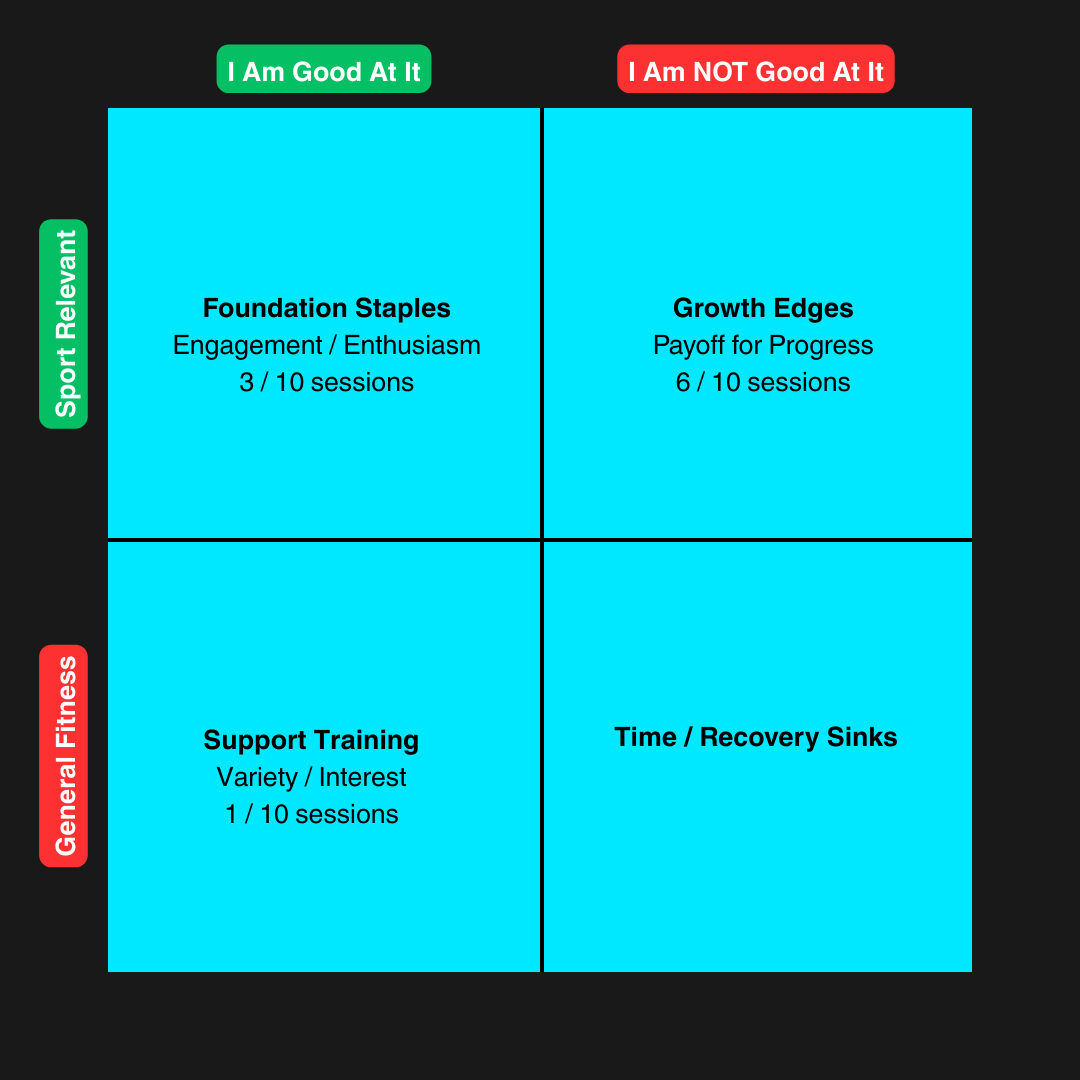
We can adapt the 2x2 decision matrix we previously used (i.e. “like vs. need” or “like vs. skilled at”) for sport-specific purposes; asking ourselves “am I good at it” and “is it relevant to my sport.”
Good at and Relevant: These are the foundational staples of our style. they promote engagement and enthusiasm (~3 / 10 sessions).
Good at and Irrelevant: This is good content for support training that helps build interest with variety and keep us curious (~1 / 10 sessions).
Not Good at and Relevant: These are our growth edges, where we should spend most of our training time (~6 / 10 sessions). What we can’t see in the 2 dimensional graphic (below) is that there can be a lot of overlap on the gradient spectrum of “how good” or “how relevant” a given practice may be (we’ll dive much deeper into this throughout these last modules).
Not Good at and Irrelevant: These are time, energy, and recovery sinks that should be avoided.
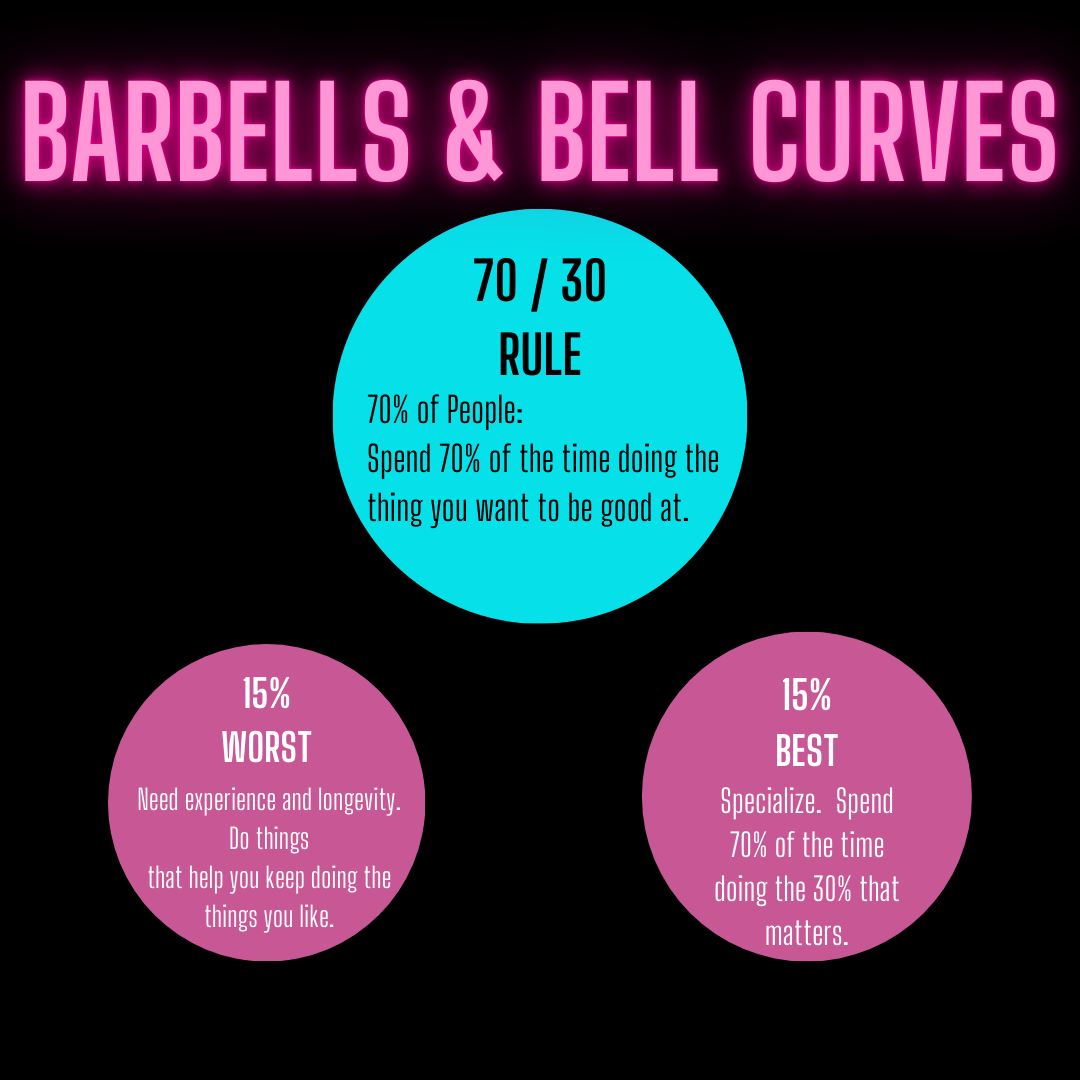
Years ago I wrote a series of articles titled “Barbells and Bell Curves” that explained, generally, that for the median (as many above as below) 70% of athletes, spending 70% of their time on skill development is a good idea. In other words, the priorities are reversed from the pyramid structure we discussed in earlier modules. These athletes already have a GPP foundation, performance and fitness need maintained, but skill development will have the highest return on investment.
By contrast, the 15% least fit will benefit from the pyramid structure as previously explained. On the flip side, the 15% most fit will like benefit from the same structure though for different reasons -- generally suffering from overuse imbalances or injuries and depleted / decrepit / ignored systems and movement patterns.
The takeaway here is that “sport” or “skill” become our seventh energy system. This means that training our other systems must not impair our ability to train, recover from, and adapt to the primary stimulus or system in-focus.