

First, thank you for starting this journey. My hope is that this will be a collaborative process. Of course, I want you to improve your health and fitness, but as described in the introduction, I also want you to get a sense of what drives, motivates, and moves you, not just physically, but emotionally and psychologically.

Rest assured, this is a serious undertaking for me to create this program as well. I reserve the right to be wrong, change opinions, and update these modules as feedback is given, experience earned, and information gained.
Let’s also clear up some legality. By starting this program or any of the modules herein, you agree that you’ve consulted a licensed and credentialed medical provider before starting any fitness or dietary program. You also agree that the elements and modules herein are not a substitute for medical or mental health advice and direct care by respectively credentialed providers of those services.
Now, let’s begin!
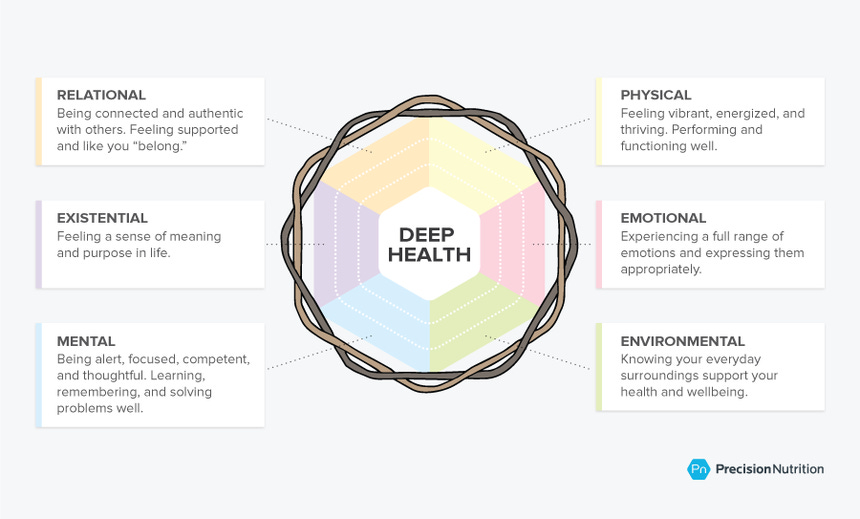
Precision Nutrition has created a Wheel of Deep Health which I think is a great place to start. Obviously, to address all of these “pillars” is outside the scope of this program. However, it’s something we should keep in mind.
Nutrition has become the frugal fighting ground for all manner of rage-baiting and speculation; so much so that it’s considered the darling of longevity. However, that’s not necessarily true. Food is only one part of one of the pillars above (physical).
I still fall into this trap. My initial thinking was that, since we all have to eat, we might as well do it intelligently. That isn’t wrong, but it is an extremely narrow scope of the term “wellness.”
While this program will primarily focus on the physical pillar, its explicit intention is to utilize physical methods to bring attention to the needs (both met and unmet) of the other pillars: existential, relational, mental (cognitive), emotional, and environmental.
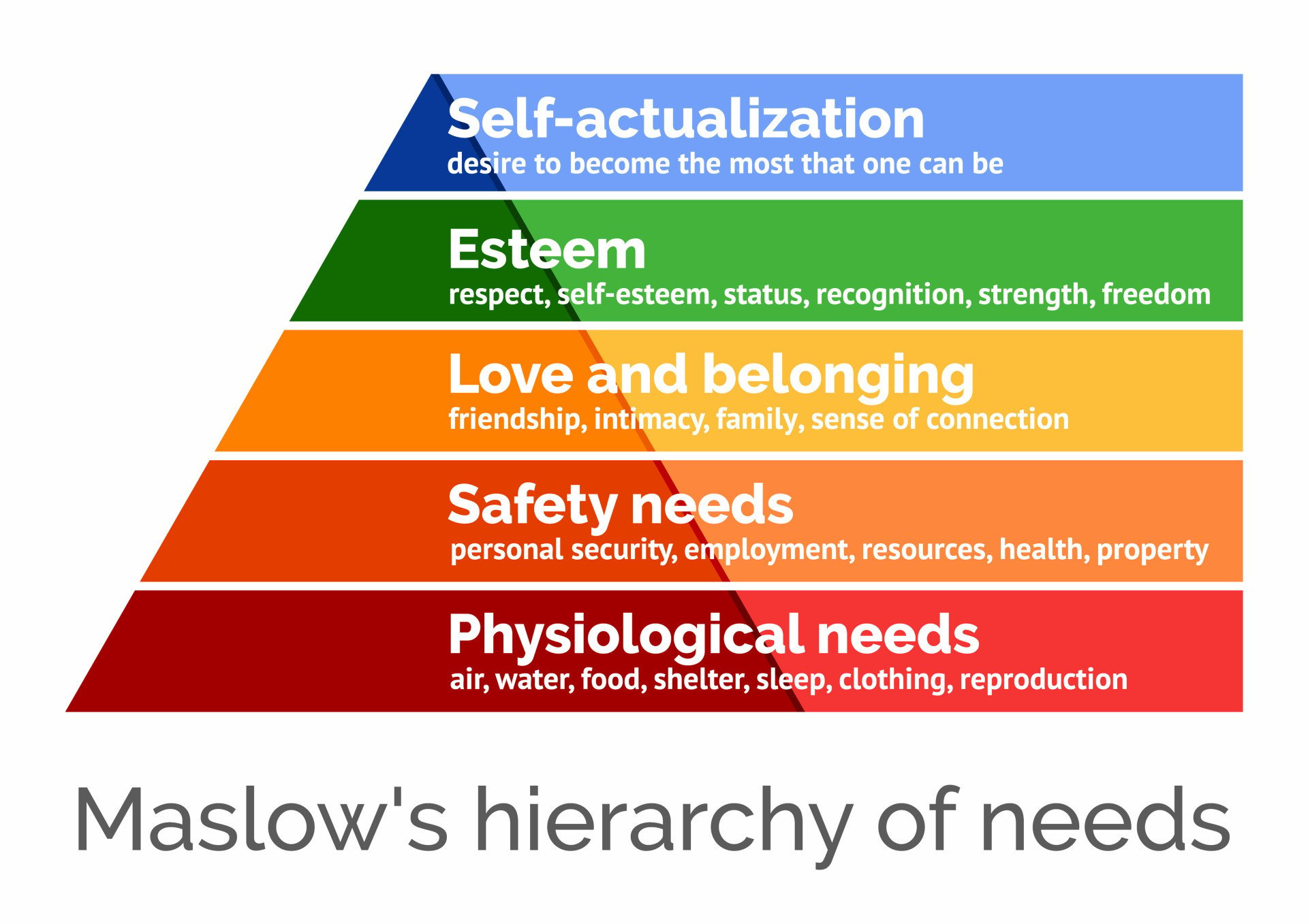
Another way of looking at this is through the angle of Maslow’s Hierarchy of Needs. Again, this course isn’t intended to be a graduate course in developmental psychology, but is helpful to have several different models and different language tools to represent the (human) experiences we’re going to be exploring and evoking.
In Maslow’s model, the more underdeveloped or unmet a lower-tier need is, the more frail – if not impossible to achieve – higher-tier needs will be. For example, it’s very difficult to convince someone to invest in their 401K if they’re worried about finding breakfast tomorrow.
Similarly, our romantic and family relationships often come at the expense of the time and energy we spend at work (safety needs). It’s also very difficult to want to invest in ourselves and see value in ourselves if that hasn’t been modeled and cultivated in our formative years. Hence, attachment theory has a very real impact.
You may be asking, what does that have to do with health and fitness?
The physiological tier of Maslow’s hierarchy clearly overlaps with the physical pillar of the PN wheel. Likewise, we can draw a lot of parallels between the safety tier and the environmental and mental pillars, the love / belonging tier and the relational pillar, the esteem tier and the emotional pillar, and the self-actualization tier and the existential pillar.
What does not get written into most discussions of Maslow’s hierarchy is that the physical domain can be used as a vehicle to explore the other tiers of the hierarchy. Obviously people improve their physical health in the gym. How many also improve their longevity at work or manage mental and emotional stress in the gym? How many people have built their entire social lives around sports practice or gym-friends – maybe even met their spouse there? Has anyone ever improved their self-image or felt more confident either in appearance or a performance achievement in the gym? Of course they have.
In my opinion, you’re not very “healthy” if that PN wheel isn’t balanced. To be clear, it’s very unlikely that you’ll perfectly max out all 6 categories – life isn’t a video game. What that means is that you’re probably doing really well in one or two areas, pretty good or about average in a couple others, and if you’re honest really struggling in the last couple.
Similarly with the hierarchy of needs, I’m assuming that anyone using this program is at least at the green / self tier. That is, you’re trying to improve yourself. Maybe there are some holes or cracks in your relationships, work, sleep habits; but generally you’ve earned the privilege of being able to look forward to and develop the future version of yourself.
I can’t promise “self-actualization”, but I can offer some tools that may help cultivate honest insight into where those repairs might be needed. Physicality and physical training offer a unique proxy for us to be able to elicit emotional responses, provoke (or contain) psychological states, as well as challenge our ability to assess ourselves, set an intention to change, and follow through with a plan to develop that change.
Before enlightenment, chop wood, carry water. After enlightenment, chop wood, carry water.