

Maybe we’re a byproduct of the industrial revolution. Maybe ‘The Matrix’ was a documentary. Maybe we’re just waiting for a supermassive black hole to return us to star dust so that we can see each other better once again.
Everyone is busy. I get it. We’re told to hustle and grind. Chants of stoic philosophy pervade the bro-sphere. Get rich or die tryin’. The motivation and hype reels are everywhere.
Worldwide we’re told that the planet is more equitable than ever. In America we have more comfort and abundance than any other generation in history. Yet, about 1 in 5 Americans have depression and another 1 in 5 have anxiety (source).
Because of my experience in both fields, I have some particularly (strong) opinions about how the “integrative wellness” community has tried to tackle this in recent years; particularly with the growing interest in comparing exercise to antidepressant medication.
I’ll have more to say on this in detail in the future, but for now, suffice to say that “conventional treatments” aren’t working and the “standard of care” needs a serious rapture.
As it’s been pointed out before, humans have never before been so connected, yet so alone. Before the advent of the internet we never had access to all of history’s knowledge right at our fingertips. Further, as AI grows, that knowledge isn’t just spoon fed, it’s shoveled into our eyes and ears.
Ironically, we have also never before behaved so inconsiderately.
I’m not a fan of pop-spirituality — or pop-psychology, or pop-music. They all miss the point and fail to capture the human spirit they’re supposed to be representing. This is like remembering and reciting half of a parable so that the narrative you internalize suits your strengths, soothes your frail ego, and fuels delusion and insecurity.
Frankly, I love reading stoic and existential philosophy as much as anyone, but I have to admit that I don’t think many of those authors were very happy with how their lives turned out.
Do as I say, not as I do, or something like that.
Recently, a colleague sent me The Starfish Poem (again). On many occasions this person has accused themselves of “bright-siding” (their term) — that is, talking themselves into or staying in too many bad situations by inventing the perception of a silver lining.
At some point, early in my career, I think I admired that Starfish story. The colleague and I had a short chat about how my distaste for it had grown over the years. The common interpretation and implication is that one ought to become a martyr or keep throwing starfish into the sea until one collapses.
“It mattered to that one (starfish)” we’re told. But the poem never inquires about the thrower. Do we stop to feel the weight of each starfish? Do we stop to admire their rough edges, broken limbs, and unique imperfections?
At what point do we decide “this will be the last one” or that “I think I’ll rest here for now… or maybe forever.” Do we stop for ourselves to listen to and smell the sea or to admire the sunset?
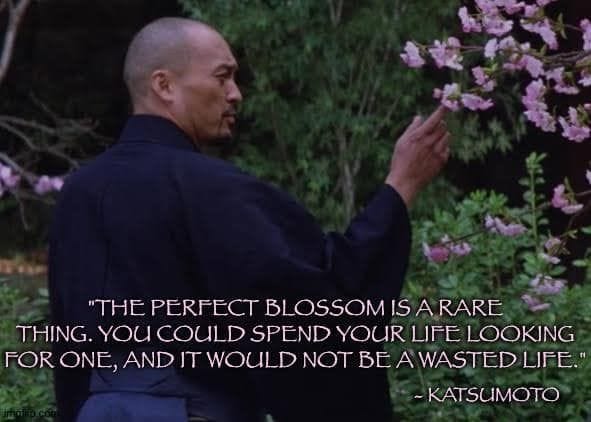
Coincidentally, or not, I re-watched “The Last Samurai” recently which fed into the conversation with this colleague. In the movie Katsumoto tells the captured US Civil War General two important messages:
“The perfect (cherry) blossom is a rare thing. You could spend your life looking for one and it would not be a wasted life.”
Later, The General says that “every soldier has nightmares” and Katsumoto responds:
“Only one who is ashamed of what he has done… You have seen many things and you do not fear death, but sometimes you wish for it… I also… It happens to men who have seen what we have seen and then I come to this place of my ancestors and I remember, like these blossoms, we are all dying. To know life in every breath, every cup of tea, every life we take… the way of the warrior.”
Maybe life isn’t about how many starfish we can save, or how many widgets we can make, or dollars we can earn, but who we can bring with us along the way to feel the sand on their feet, the waves in their hands, and greet the sun with their face.
If we are hellbent on “imagining Sisyphus happy” then we ought also recall that Sisyphus doesn’t chase suffering (labor, burdens, or starfish). He watches it leave and then descends towards it again with poise and grace. The scorn that drove you to mountaintops won’t help you find cherry blossoms in perdition.
Really enjoyed this one, thanks.