

General workouts don’t address specific needs or deficits. You may like to think you’re training “for the unknown and unknowable”, but your history, skills, injuries, and genetics, are anything but that.
It’s your responsibility to interpret that information honesty and apply it effectively.

Part of CrossFit’s core methodology is The Hopper Model. Defenders of this model (exhibit 1) note that the it is designed to “address readiness and ability… not the preparation.”
That is, precisely, part of the problem. As I’ve noted before, individual skills and capabilities are not any more coincidental or random that the inputs of the aforementioned hopper.
This is something I’ll come back to below, but for now let’s consider how “lottery balls” — the inputs for the hopper — are mislabeled and misunderstood.
A lot of training and programming theory discussions start with metabolic pathways. The main problem here is that, under the guise of being “scientific”, the common definitions of phosphagen, glycolytic, and oxidative pathways become self-limiting.
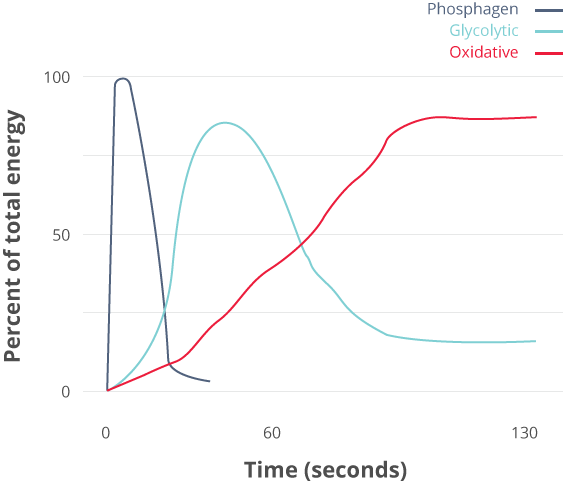
For starters, graphs like the one above suggest a false dichotomy; implying that we can only be training in one of those pathways at a time. This is false. In fact, it is inverted. All three energy systems are operating all the time.
Further, are we really expected to believe that any interval beyond 120 seconds is a test of endurance? Hardly.
But, this isn’t just an undergrad physiology or CrossFit-specific problem. It is pervasive across the entire fitness industry. This is largely why I’ve shifted to defining fitness taxonomies based on experience and sensation.
Perhaps, what may be worse than an arbitrary definition is a circular, self-referential one. I’ve critiqued CrossFit’s 10 Physical Skills before and still stand by my comments.
The items themselves are a quite good. The problem, for example, is that no one on Earth — outside of CrossFit — defines “speed” as “barbell cycling.” Who is the fastest wo/man on Earth? The answer is, always has been, and always will be answered unanimously as the Olympic winner of the 100m sprint.
On that note, how can we claim to test “endurance” when most competitive (CrossFit) events are 9-20 minutes and averaging around 12 minutes (in open workouts in the past 5 years)?
The proffered definition of “endurance” is “the ability of the body’s systems to gather, process, and deliver, oxygen.” Physiologically, that is the definition of aerobic capacity, not endurance.
There are, of course, other examples, but the point of this article isn’t to bash CrossFit. It’s to use a prolific industry standard as an example of how taxonomies and programming (not to mention ideology) can lead us astray.
My point here will be that:
Outsourcing your programming to a hopper (or AI chatbot) undermines the exact intuition and creative problem solving your training is likely already ignoring.

Most training programs give you a 2-axis taxonomy that looks something like:
Axis 1: Muscle Group / Body Part (e.g. push, pull, legs)
Axis 2: Energy System (e.g. power, hypertrophy, endurance)
I find that to be woefully inadequate, though I have to actively resist the urge to over-complicate things myself.
As some of you know, the seed for my Integrated Fitness Problem program came from a chat with and writing a few sessions for We Are Heavy Meta; where Michael and I were discussing physical training to elicit emotional sensations.
After that I spent the last 6 months (the end of 2025) fleshing out the following categories in direct opposition to conventional Axis 1 entries:
Love (endurance)
Hope (mobility)
Resilience (hypertrophy)
Anger (power)
Valor (anaerobic capacity)
Anguish (aerobic capacity)
Axis 2 gets a little more interesting. Often this is intended as some sort of difficulty indicator — the common descriptors of which all have major short comings.
A percentage of 1RM (one rep max) or Max HR is a poor indicator of what I am capable of on any given day. This is the major down side of cut-and-pasted spreadsheets or AI-vomited training programs. Even the best coach in the world can’t predict what your training stressors (let alone other life factors) will look like 6-weeks from now.
RPE (rate of perceived exertion) is a little better, but how many coaches or athletes are actually taking the time to develop the sensitivity and awareness required to accurately pin the difference between RPE-7 and RPE-8, or RPE-2 and RPE-5 for that matter?
Getting a little closer, and much more helpful, we could define this “difficulty” by what the limiting factor of a session is. Is it “hard” because I cannot move efficiently? Because I cannot breathe? Because I cannot contract harder?
Ultimately, I feel like the discussion of “limiters” really leads us back to what “adaptation” we’re trying to drive in the Axis 1 category we’ve chosen to train on a given day.
For me and my athletes this has come down to three main categories:
Rebound / Shakeout
This isn’t lackadaisical milling around we claim as “active recovery.” It has an explicit intention to feel better after the session than when we started.
Cultivation
Here we are trying to ask questions, seek new experiences, or acquire new skills.
Development
These sessions progress deeper adaptations in skills, movements, and implements already known.
Additionally, I sometimes note “Team” and “Test” difficulties, but those are typically for special occasions that warrant their own articles.

Sometimes good ideas are simple ones, because what makes them “good” is that they’re easy to implement. So, I have to give credit where it’s due.
The Opex taxonomy of energy systems is dang good for a 3-tier (Axis 1) system:
Pain (capacity / metabolic conditioning)
Gain (strength / power)
Sustain (endurance)
However, I was recently thinking that this maps just as well on top of an Axis 2 “adaptation” hierarchy:
Pain — spend and wager your money.
Gain — build skills and revenue streams.
Sustain — put money in the bank.
Regardless, the image I’m trying to convey is that we could literally get series of physical hoppers, or computer programming databases, to “randomly roll” across tables of:
Intended Stimulus
Energy System or Muscle Group (Hopper 1)
Difficulty or Adaptation (Hopper 2)
Session Structure (Hopper 3)
AMRAP, EMOM, for time, straight sets, ladder, etc.
Movements (Hopper 4)
push, pull, hinge, squat, carry, jump, etc.
Implements (Hopper 5)
barbell, dumbbell, sandbag, medball, bodyweight, etc.
There you have it, a perfect programming scheme, right? You never have to pay for another PDF challenge or training subscription again!
Except, there are always more of those things for sale, by the dozen, every day. Why?
Because they fail to deliver what is actually important. The thing your training is actually missing, what’s underdeveloped, and what’s likely the catalyst for your next big breakthrough.
As foreshadowed above, I highly suspect that those catalysts are:
Intuition
Creativity
Just the other day I was talking to a client who finds the idea of enjoying going to the gym beyond absurd — completely unfathomable that exercise would be anything other than a means to an end.
Precisely.
It “sucks” because you have not yet learned to love — perhaps much of anything. It is certainly much easier to love something that you’ve created yourself. So, find a canvas and pick up a brush.
An intuition that has never been developed is even less trustworthy than one that’s been hijacked, abused, or lead astray. It needs freedom from consequences, or a little “chaos to birth a star” as Nietzsche put it.
The point of training is to know, to feel, to move, and to change yourself.
That’s the infinite game.
A hopper can’t do that. A Python script can’t do that. An AI chatbot powered by an array of quantum computers can’t even estimate the possible outcomes of trillions of human genetic combinations across quadrillions of life experiences and quintillions of fantasies, fears, and expectations.
Desperation for certainty is a veil for the cognitively dissonant and insecure. To “train for the unknown” you’re going to have to go to the place you least likely want to look.
Inward.