

Rigid things break. As much as “nothing is new” in fitness, a lot of trainers have been regurgitating the same exercise templates and rep-set schemes for a decade or more. Furthermore, the mass psychosis of our modern world pushes us towards fixed identities and binary conclusions.
With that in mind, I want to review a few trends and tools that I once turned my nose up at and have since implemented into my training. Of course, the punch line here is that I had to challenge myself in order to change myself; starting with a more honest evaluation of folks who did / do things differently than myself.
In the simplest terms, I needed to re-direct impulsive criticism towards solution-focused curiosity. There are plenty of shenanigans online and in public gyms to criticize, but it turns out we learn a lot more and get a lot better if we also ask:
What’s going on here?
What is this person trying to achieve?
What are they getting right?
Kipping:
First on the list is kipping, because it maps out the overall decision tree and evolutionary process well. Until a couple weeks ago I had never been to a formal CrossFit gym — shocking! Owing some confidence to naivete, I had no idea that it was competition season and threw myself at the Rx’d (prescribed) open workout preview (26.2).
I didn’t finish (DNF) and only attempted a single ring muscle up. My biceps were in agony for a week. Why? Prior to that day I had never attempted a kipping pull or even a bar muscle up, let alone on rings. So, those dozens of pull ups were all done strict(ish).
Traditionally, I had frowned on kipping because I saw no utility in a “cheating” movement. Later, I budged slightly and acknowledged kipping as “good for practicing building momentum towards muscle ups.”
Why do something as goofy looking as butterfly pull ups when you could just do them strict? Was it just so you can “cheat” and squeeze out more reps? I’ll talk about partials below, but the real kicker here was; “Why does an organization like CrossFit encourage this movement? Surely, it isn’t random and unintentional.”
Because I have a black belt brain, when I’m not able to do something, I want to figure out why. So, I went to YouTube like everyone else does, then back to the gym to start experimenting.
I deduced that, as I already knew, my shoulder flexion and thoracic extension are moderate at best. Furthermore, the “tempo swings” to practice kipping, are a much different sensation than a child swinging like a pendulum under the bar. The “arch” position must be achieved to then build up to larger “arch” and “hollow” positions.
This experiment became a useful observation in im/mobility. The hanging “arch-to-hollow” transition is a high-velocity audit of your ability to transfer power through your spine. Just like a whale, alligator, shark (etc.) waving their tails for locomotion, the corresponding “core” musculature is also tested.
Recently, there’s been a trending fitness interest in “coiling” and “elastic recoil”, but again, these ideas aren’t new even if they’re newly (re)discovered.
Partial Reps:
Similar to the kipping debate, “why would you (want to) cheat by doing partials or less than full range of motion?” I came up with a few examples that satisfied my curiosity:
Injury: If it’s between training a partial range and not training at all, I want myself (and my clients/athletes) to keep training. Load isn’t always the issue or limiting factor.
Contraction Speed: What’s the difference between a “thruster” exercise and a push/power/split jerk? If “full range” is always superior, why do Olympic lifters only do a “partial” dip between the clean and the jerk? Obviously, the speed of contraction and end expression are much different when the range of motion doubles or triples.
Target Expression: Similarly, many high level lifters execute movements at a deficit (feet higher than the floor) or with the barbell “on blocks” which allows them to target specific sections of the full range where they may be struggling or otherwise want to develop.
Carbs:
I don’t want to beat a dead horse here, but I had to throw this one in. For over three years I was hard on the keto/carnivore kool-aid. As I’ve mentioned previously, I don’t think those were necessarily “bad” interventions — in fact they likely did help with some things.
However, they also had an expiration date. There are all kinds of examples of people “doing X physical feat” (e.g. running a marathon) on all kinds of dietary practices. The real question is, “are they winning?” In other words, as much as pundits preen about “what is optimal” they’re still settling for “what is possible.” This is an unfortunate irony based on their predilection to assert what people do / don’t “need” without any context towards what they want to achieve.
People have run marathons carb-loaded, fasted, fueled by beer, and with a cigarette hanging out of their mouth. Does that mean we should all adopt those practices as well? Should we, as coaches and professionals, recommend them without asking a few more questions? I say “no” to both.
Foreshadowing a later article, I went from < 50g to over 300g of carbs per day. I’m still about 10% body fat and my morning blood glucose is ~100. Clearly there’s more to this story than just “carbs make you fat and diabetic.”
Bands:
I don’t think I ever thought resistance bands were silly or impractical, just often misused. Personally, they were an extremely important cornerstone tool when I rebuilt my knee (meniscus and MCL tears) in 2024.
For this purpose, I thought they were great. However, I’ve seen all kinds of “band assisted” movements and even the outright replacements of a barbell. The balance, durability, and ability to distribute and apply load (and it’s subsequent incremental overload) through a barbell is second to none.
So, what else have I learned to use bands for other than injury rehabilitation? Well, in the broadest sense, if something is effective for reactive rehabilitation, it’s a reasonable consideration for preventative measures as well.
To this day, some internet doctors and trainers turn their nose up at variable force / loading. But, if we change the range of expression (like an almost closed versus almost all the way open elbow angle in the case of a bicep curl) our tissue responds differently. This is a fundamental difference emphasized by FRC and the internal model of strength.
If you do not understand that end ranges compromise contraction expression, then I’d guess you aren’t really training a “full range of motion” anyway, which brings us back to the earlier discussion about partials.
You ought to have a better answer than “it was heavy” or “locking / bottoming out is bad for your joints” — because both are missing (and making) the point here. It’s an incredibly valuable intuitive development to know exactly when (in a range of motion) and how much weak you become at certain points. Counter-intuitively, the more we fear, avoid, ignore, or injure these end ranges, the more our tissue resilience atrophies and we become the immobile “muscle-bound” trope.
Additionally, the variety of angles of expression we can use bands for is tremendous. Gravity will always pull a barbell (KB or DB) towards the floor. So, we’re always working against gravity which makes a lateral raise, overhead press, and bench press all feel much different (for example).
Simply tethering a resistance band to a DB on the floor, pull up bar (overhead), or power rig / squat rack (laterally) allows the same resistance at the same angle to be applied to many different movements (e.g. extension, flexion, or rotation).
Wedges:
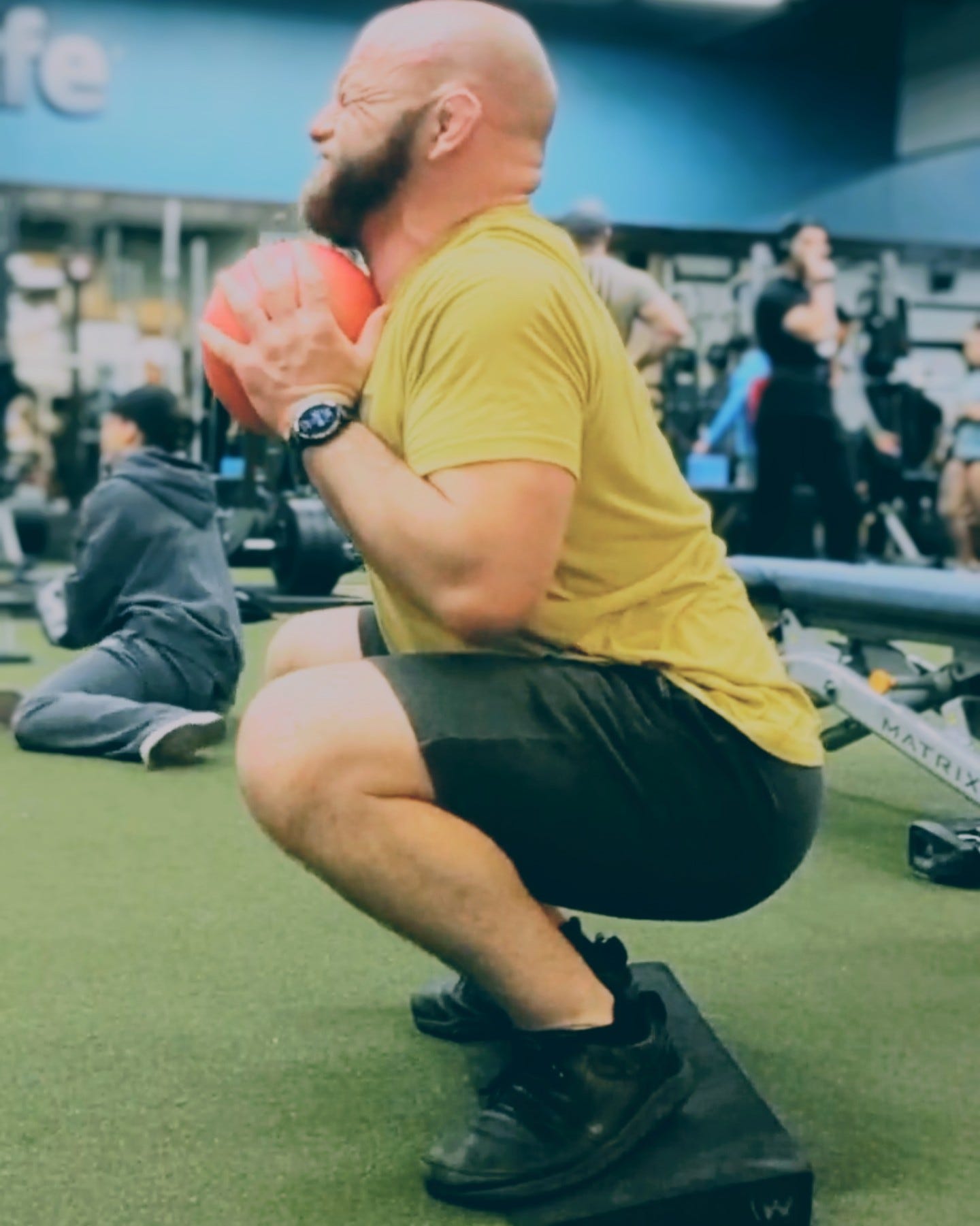
Similar to bands, tools like foam/wood squat wedges have a clear utility and clear limitations. The narrative that I told myself was similar to other “cheating” narratives; that if the goal was to squat deeper, then I should just do that flat footed.
However, I was confronted with a few astute reality checks:
Do Olympic lifters compete in flat shoes? Absolutely not. They have a hard, slightly elevated heel. Why? It helps push the hips forward and the knees in front of the toes, which makes it easier for the spine to stay erect, thus the load is better supported at or above head level.
Looking in the mirror at my own flat-footed third world squat, my back is still fairly rounded. Why? If ankle mobility, rather than hip mobility, is the limiting factor, then because my knees cannot push over my toes, the spine will round to maintain balance so I don’t fall backwards on my butt. Putting my heels, even partially, on a wedge helps “encourage” correct positioning and lets my hips, knees, and back “feel” how they’re supposed to move through space without needing to overcompensate (which reinforces the adaptation of inefficient biomechanics).
I had previously worked with an athletic 250+ lb client who couldn’t squat below parallel. Telling him to “just do more third world squats” wasn’t going to be helpful and the only thing it encouraged was frustration. Furthermore, squatting with a PVC pipe was a distraction since the load wasn’t great enough to tell his tissue to behave differently. Alternatively, a mild load of 135# back squat was enough “traction” to give feedback without any risk of threat. In other words, he was always going to be able to squat 135# without a problem, but it helped “push him down into the hole”; thereby reinforcing confidence at full depth.
Conclusion:
These are just a few examples of tools and trends that I’ve had to question, validate, and re-evaluate my beliefs about and practices interacting with. The real take-home message is that while elitism doesn’t need defending — excellence should be the standard — attitude and culture absolutely matter as well.
It doesn’t matter how “right” you are about something, if your system(s) and beliefs are rigid, they will eventually grow brittle and break. Life is not stagnant and therefore neither should our training methodologies.
We have a similar problem if you (1) jump on a new gimmicky tool or terminology every month or two, as we do if you (2) look back and haven’t changed anything in 10 or 20 years.
One never gains traction and is always bucked around by the waves on the surface while the other sinks like an anchor and is forgotten.
The Integrated Fitness Problem

I’ve created a 12-module / 12-month program to develop general physical preparedness (GPP) and grappling (BJJ) specific conditioning in two separate phases. This isn’t just another PDF fitness program or 30-day or 90-day challenge. This is a call-to-action for you to invest in choosing your own adventure. It’s an invitation to move how you feel and feel how you move. The overlap between our physical and emotional states has a lot to teach us about how we move outwardly and feel inwardly.