

One of the many conundrums in modern martial arts, jiu jitsu in particular, is that there’s an ongoing identity crisis. Many (instructors) fantasize about the reverence of traditional martial arts while simultaneously demanding the respect of modern (combat) sports.
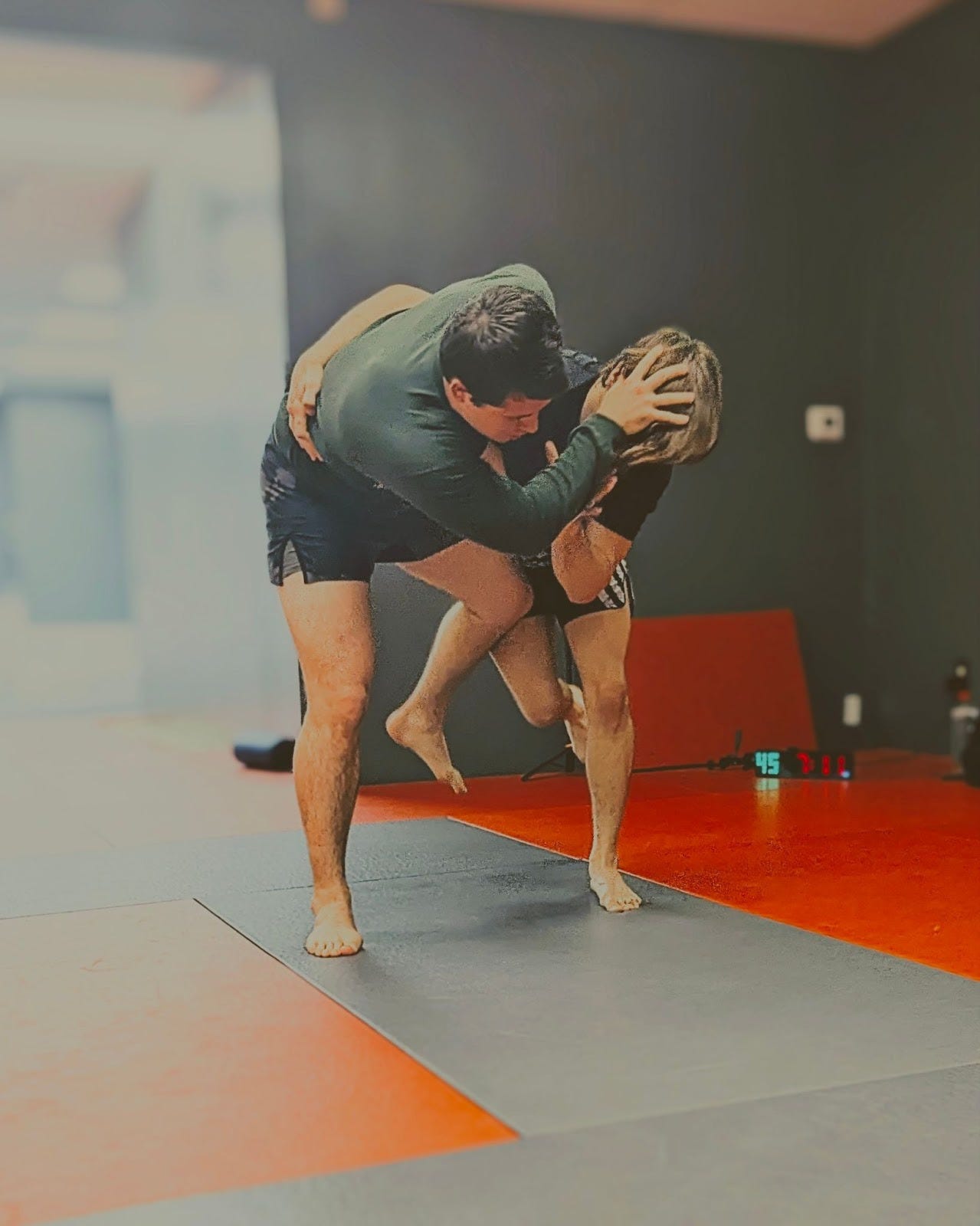
One area where this is painfully clear is in the realm of strength and conditioning. Another is how we structure, or are told how to structure, training practices. This seems to come to a head in the “eco vs. drilling” debate. What I will say on that specific matter for now is that it’s often easier to teach advanced students than it is novices as the advanced students have enough foundation to allow many more multitudes of creative application.
I was having a post-training strategic discussion one day with a high-level wrestler. Naturally, we were discussing different “games” and “chains” of “drills.” He is an accomplished wrestler, I’m a black belt, and we were prepping a teammate for ADCC trials.
Individually, and certainly combined, we had enough experience and skill to cultivate and develop many nuanced sequences that were beneficial to our needs. Later, we also talked about how to apply similar “games” to all class levels. I pointed out that one of the problems with that is that some of our beginners look at me like I have a third eye when I say “shrimp” or “sit out” or “high-c”, how are they going to “chain wrestle?”
To be fair, this isn’t the students’ fault. It’s a coaching error. We’re asking people to read a PhD physics text book on their first day of high school shop class. The question isn’t “which” (ecological or drilling), but for each, “when?”
In some academies, no need to name names, it is common for the coach to run the shit out of you during the “warm up” with ad hoc calisthenics and context-less line drills, seemingly only so that they can assert their dominance during sparring.
The relevance to our discussion about practices of “martial arts” compared to “combat sports” is that just like supportive training (strength and conditioning), there’s still a lot of growing jiu jitsu has to do in terms of how we structure on-the-mat training if we want to continue being considered contemporaries with other combat sports.
Above, I gave an example of a poorly intentioned and poorly executed warm up. It’s worth noting as well that from a neuroscience perspective, this is exactly how you minimize one’s ability to incorporate and implement new behavioral patterns. The nervous system must feel relaxed in order to consolidate memories, and when hyper- or hypo- aroused will have a very hard time integrating new information because it feels threatened.
But I digress…
We can do better. We owe it to ourselves and future generations of grapplers.
For being just short of 7 minutes, Kolat gives us some excellent resources and paints a picture in broad brush strokes.
A good warm up should include both general and specific movements. On the general front, people aren’t paying for a grappling class to learn how to do jumping jacks or yoga, but we should get some blood flowing and do some mobilizing.
In the specific sense, we should also touch on some foundational skills and movements every day – queue tumbling, line drills, pummeling, grip-fighting, stance-in-motion, etc. Lastly, we can get even more specific with some light, constant-pace drilling (call it “chain” sequences or “games” if you’d like).
However, don’t take my word for it, let’s look at some of the best wrestling programs in the country:
One of the things that stands out to me in this video is the maturity and composure of Tom Brands. Obviously at a program like Iowa there are plenty of hard days, but the video isn’t a highlight reel of torturous grueling workouts.
It’s asking your athletes to know the difference between what they want and what they need and trusting them to follow through. The purpose of a long warm up isn’t just to prepare the body, it’s an opportunity to assess your mind and your body.
Does the “standard” warm up feel harder than usual today? Does that mean I need to work on my conditioning outside of practice? If I can’t do a handstand should I work on shoulder mobility? Is feeling tired a one-off and I should roll light tonight, or is it becoming a trend and I need to re-evaluate rest days?
We see more of this in another Iowa video where understanding intensity and pacing is paramount. We’ve all seen plenty of novices and even colored ranks behave like they’re fighting off a murderer or in the ADCC finals every round.
Sensitivity is a skill. Most people don’t have the skill to tell the difference between 30% and 70% resistance, certainly not when we start adding stimulation and introducing more chaotic variables. This is a very good case of “constraints lead” or “situational” sparring, with intensity being one of the constraints.
Notice the playfulness in the “light drilling” rounds in the second Iowa video? Notice also that they didn’t stop after one or two reps? A big part of BJJ is the community and socializing, I get it. But, training time is best spent, well… training.
There’s a consistent line from Tom in both videos that “light” refers to pace and not commitment or in/attention to detail. If what you mean by “flow roll” is let you win or do whatever you want, I’m out. If you mean “play” and try to “learn” opposed to “win” – see reference to neurology above – then I’m interested. The caveat is that I must accept that I will “lose” most of these exchanges.
Again though, that isn’t an excuse not to “try” or to reinforce bad habits or be inattentive to detail.
This Illinois video has some of the most fun nuggets and movement ideas. It’s a pre-season practice, which is generally the most applicable context for jiu jitsu. We don’t have a pre-defined season, so typically we’re always in “pre-season” unless specifically preparing for a competition.
Watch this one a couple times and pay attention to the different mobility and movement drills taking place. It’s a helluva lot more useful than (only) static stretching.
In the Nebraska video we have several repeating themes.
Balancing having fun and going hard.
Trusting / Teaching athletes to warm up “on their own.”
Trusting / Teaching athletes how to address their needs.
Warm ups include mobility, aerobic, and skill components.
One additional thing I noticed is that observed conditioning equipment is minimal, simple, and effective – bikes, dumbbells / kettlebells, pull up bar / climbing rope, sleds, etc.).
Tradition is a trap, and it also has utility. Yes, beginners should first learn some basic movements before “playing” in the open or even in “constrained games.” There’s also a short shelf life on that practice. For example, being the fastest shrimper in class is useless if you can’t do it with someone on top of you. So, these drills need context.
While people are coming to grappling class to learn to grapple, they should also learn to be attentive to their own body and individual needs, both acutely and chronically. A little aerobic and mobility work is a useful tool for this. I recently told one athlete that if he’s going to compete in 3 x 5 minute matches and is “gassed” after a 15 minute jog, we’re going to have problems. Likewise, if you can’t come close to touching your toes, you can’t really push your butt out from under an opponent and “hip escape” as well as you could.
Lastly, there are a few things I’m convinced we can never be too good at in submission grappling and those are takedowns and (submission) escapes. Those are things I work every day in class. If I can (hypothetically) always score first, never get submitted, and have a relentless pace, I’m going to be very hard to deal with in any ruleset in any skill / age division.
With this information in mind, here’s a sample 20 minute warm up template that I’ve been running students through the past few weeks:
Minutes 0 - 5: Areobic
Jog x 1 min
Jog Backwards x 1 min
Shuffle (left) x 1 min
Shuffle (right) x 1 min
Skip x 1 min
Minutes 6 - 10: Mobilize
Lunge + Cossack Squat x 1 min
Carttwheel (or Round Off or Chimp Walk) x 1 min
Back Roll (+ headstand) x 1 min
Forward Roll (from hand stand) x 1 min
Breakfall + Technical Stand Up x 1 min
Minutes 11 - 15: General Skill (for grappling)
Stance-In-Motion x 1 min
Pummel Drill x 1 min
Stance-In-Motion x 1 min
Grip Fight x 1 min
Stance-In-Motion x 1 min
Minutes 16 - 20: Specific Skill (for class)
Creativity Continuous Flow (focused on last week’s material / positions)
I can’t imagine a more overlooked and underrated concept than the warm up
The first BJJ gym I went to had everyone start with line drills, which I believe have a place, and then drilling arm bars and triangles and omoplatas from closed guard without demonstrating (and it was my first few weeks) then a few more line drills
I was 20 minutes in and the best thing I got out of it was I shrimped a few times. I was stressed about not knowing how to perform the moves we were supposed to do 20 times each direction, I even worried about it days I was NOT training.
Not to mention how important a warm up is to prevent injury, but some gyms accept going 90-100 percent 2 minutes in to class and I’m fighting off a guillotine for 3-4 minutes straight if I don’t tap. Nearly every injury I have had comes from the first roll of the day if I am not warm enough.
And I DEFINITELY did not show up to class to do multiple sets of 10-20 burpees.
And I STILL have never hit an arm bars from closed guard against anyone of my skill level or better.