

Some folks are pushing the envelope deeper, some are pushing the field wider and reaching further, some are content to role play a narrative we all know isn’t true.
What I’d like to challenge here are published protocols and accepted practices among many CrossFit athletes and, explicitly, headquarters (HQ).
I’d like to present a call to accountability for the ardent worshipers who either cannot, or will not, think for themselves. What I’m going to be very critical of in this article is the theology that promised physical sovereignty and delivered a centralized corporate leaderboard.
While my formal exposure to CrossFit has been limited to the past few months, that does not change the truthfulness or accuracy of my points below. I don’t require an appeal to authority to be correct, though you’re welcome to review this site’s archives for receipts.
I’m not just punching up at the biggest target I can find — while it’s tempting and easy to do. I can’t help but be lured into a much needed somatic and academic autopsy of methodology.
Many others, who have decades of exposure, have made similar criticism. I’ve met great athletes, great coaches, and trained at great gyms — and many “not great” ones as well. To say “CrossFit is bad” seems quite unfair, there really is no debate that any movement or brand has been more influential in the fitness world over the past 20 years.
Nevertheless, if you’ve persisted for 20 years and refuse to change, your stubbornness belies your ignorance.
First, I want to set the stage for my perspective so that readers will fully understand where I’m coming from and know that this isn’t another nauseatingly pedantic "I tried X for 30 Days” clickbait article or video.
Around 2022 I was introduced to Brian Mackenzie’s work through his company Shift Adapt and have been a fan ever since. Around 2015 Brian published a seminar (PDF) applying cross-training and interval protocols to a methodology that would challenge endurance and running orthodoxy.
This became known as CrossFit Endurance (CFE) and is also explained much more deeply in Brian’s book “Unbreakable Runner (2014).”
In the book Brian challenges the religiously held belief that the answer to better endurance is always “more” — more miles, more running, more injuries. The core hypothesis isn’t necessarily that intensity can make up for volume (it surely cannot, no matter how many peer reviewed journals try to convince us otherwise).
The idea is that:
Running is a skill, that needs developed separate from metabolic throughput.
“Conditioning” can, and should, be trained and cultivated via varied cardio-respiratory (ventilatory) thresholds.
If you want to be “fast”, regardless of the duration or distance, you cannot (only) train to be slow.
Fast forward another decade or so (2026) and we see many of the exact same criticisms of orthodoxy plaguing the proprietary whiteboard model:
“Program for the best…”,
just do more,
just go harder,
just go / do the work faster,
just keep coming,
just scale down (but Rx is the real workout)…
Bollocks.
One gym I went to had a nice list of “commandments” that included “CrossFit won’t injure you, your ego will.” While that’s a good individual reminder, I would contend that that sentiment ought to be extended to coaches, gyms, and their respective programming allegiances as well.
Node (ref.):
a pathological swelling or enlargement.
a discrete mass of one kind of tissue enclosed in tissue of a different kind.
an entangling complication.
Node 1: The Performance Kayfabe
The centralized blueprint has established a definitive tagline of “forging elite fitness.” However, if one is more cynically oriented, you might reframe that as “curating leaderboards.” Therein, the corporate definition of fitness is “work capacity across broad time and modal domains (CF Journal, 2021).”
To accomplish this, there are 10 neatly defined “physical skills (CF Journal, 2021)” which comprise those time and modal domains:
Endurance
Stamina
Strength
Flexibility
Power
Speed
Coordination
Agility
Balance
Accuracy
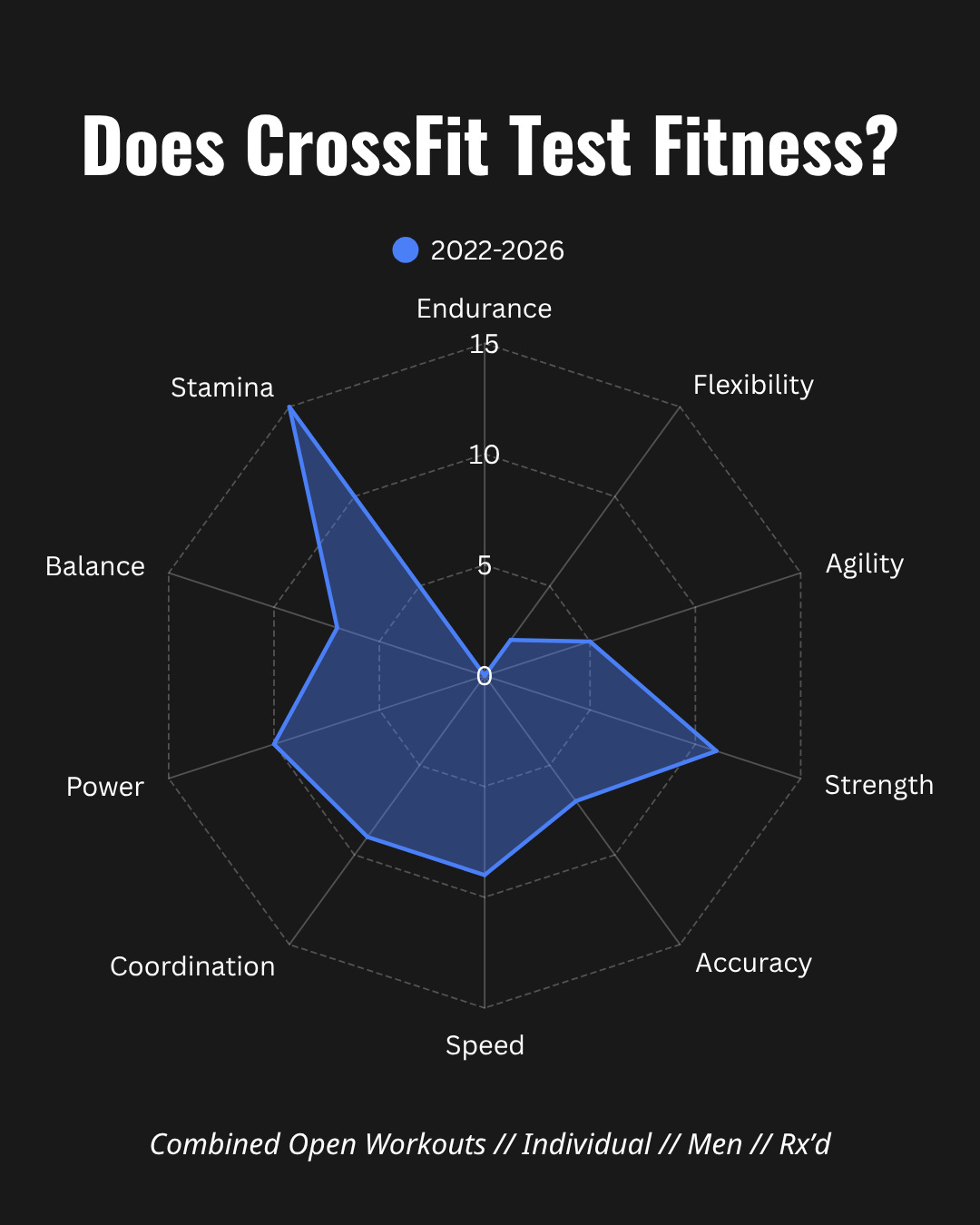
Looking at the aggregate of open workouts from the past 5 years, we see quite an imbalanced distribution of these skills. As mentioned in the introduction, I’m not the first person to point this out. WOD_SCIENCE has published data critiquing both the limited time domains (here) and strength / power bias (here).
Other sources (Beers, 2021) have taken note that the average CF women’s weight went from 137 (2009) to 143 (2016) and for men it increased from 184 to 194 in the same time span. More recent research (2023, here) suggests that “optimal” performers may tend even higher towards 155F/200M. Obviously this is a trend that follows programming bias, not the other way around.
So, what we see is quite the deviation from the foundational philosophy that:
“The goal is to get as good at as many physical endeavors as possible, over as many time durations as possible, throughout our entire lives. He or she who is best at the most skills and drills pulled from an infinite list of sports, workouts, and activities is most fit. (Widman, 2009)”
My concern here isn’t necessarily that any of the definitions offered are inaccurate, or that those 10 skills aren’t important. My concern is that, by CF’s own definition, it does not test fitness. It curates optics.
Continued from Widman’s 2009 CF Journal article:
“We say that CrossFit is the most effective fitness program in the history of the industry, and we have the numbers to back that up. No other program is producing athletes capable of greater work capacity in more domains at all age groups. Our prescription is constantly varied, high-intensity, functional movements.”
… except that that “prescription” is not the actual competition as indicated by “open” workouts that are intended to preview the actual “games.”
Not only do elite athletes in other sports not do random WODs (workout of the day), CF’s own elite pantheon (Froning, Fraser, Hopper) aren’t doing random workouts either. They’re tactically improving skills — something we’ll dissect in Part 2.
What’s more is that difficulty (which is often narrowly assumed as “intensity”) is not a universal variable.
The mechanism of what makes a particular training session “harder” — i.e. the targeted adaptation — isn’t just a matter of lag metrics like “faster, heavier, or more reps.” It is a completely different metabolic and somatic experience.
It would not be the worst idea in the world to say:
Here are the attributes that define “elite fitness.”
We have competitive “games” to test each of those attributes.
Therefore, for 10 traits, we have a decathalon over several days.
I don’t buy the line that specialized events, particularly endurance, would not make for “good television.” The Tour de France is one of the most watched events in the world every year — 33M views in 2025 (Lead Out, 2025).
Astonishingly, the World’s Strongest Man is more watched than golf or the NFL at > 200M views per year (Sims, 2023). CF Games viewership peaked in 2020 with 17.7M views and has crashed to 5.5M views in 2024 (Davies, 2024).
I also don’t buy the line that gyms need to be beholden to the 1-hour class schedule. Says who?
My BJJ classes are regularly 90 minutes. Open Mats are 2 hours. How long is your average high school football practice or rec league adult softball game?
If you want to be treated like a legitimate “sport”, start acting like it. That means training with an intentional rather than ideological structure. What is stopping you from saying, “classes are blocked in 2-hour increments so that we can adequately address varied domains and modalities of fitness?”
What if you don’t need a whole 2 hours for a capacity or “metabolic conditioning” sessions?
Well, I don’t know maybe actually work on the skills of movements(!) — covered in Part 2 — or find a way to make that blasted word “community” actually mean something.
The Integrated Fitness Problem

I’ve created a 12-month program to develop general physical preparedness (GPP) and grappling (BJJ) specific conditioning. However, this isn’t just another PDF fitness program or 30-day or 90-day challenge. This is a call-to-action for you to invest in choosing your own adventure. It’s an invitation to move how you feel and feel how you move. The overlap between our physical and emotional states has a lot to teach us about how we move outwardly and feel inwardly.
Editor’s Note: The Open Workout graphic was updated 5/25/26 after my human review of Google Gemini’s qualitative assumption. Read more about the analysis and conclusions in this Substack Note.