

The ADCC World Championships just wrapped up for 2026. In Part 1 we looked at all the technical numbers ranging from win method frequency, submission frequency, point spreads, and broke it all down per division as well!
Here, in Part 2, I want to talk about the narrative, the standouts, and the future.
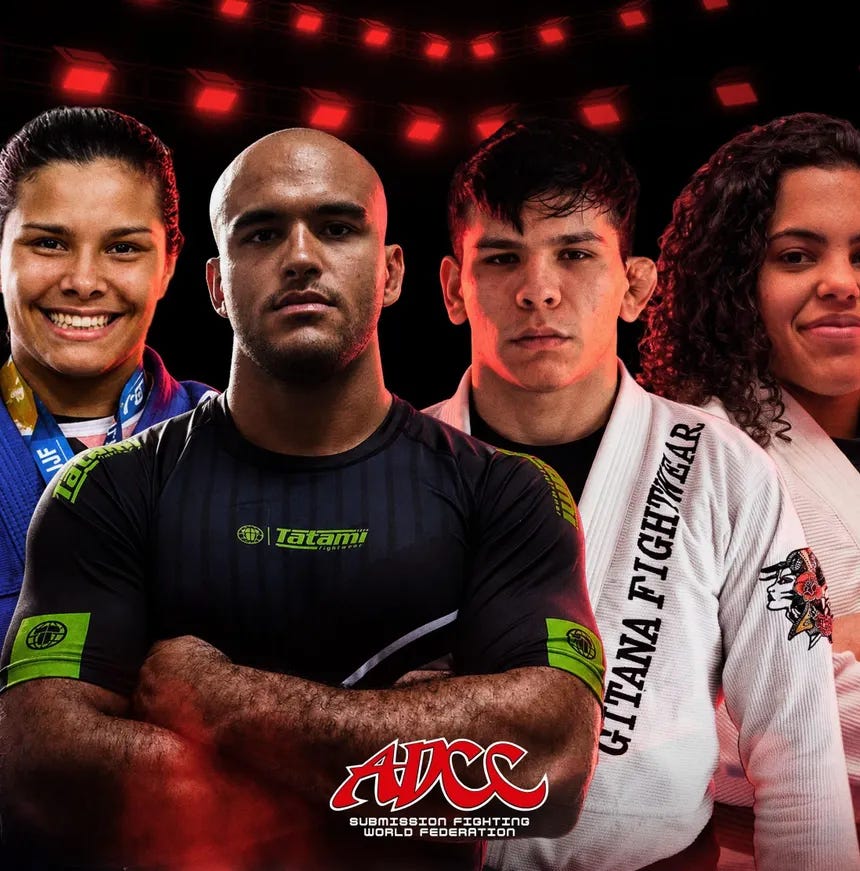
Standout Performances:
Key Upset: Josh Saunders over Felipe Pena
Every year there are always upsets, though the lack of “star power” in this event made many of them feel less astonishing in my opinion. However, Josh over Felipe absolutely brought back vibes of 2019’s Nicky Rod over Cyborg.
I think it was the right call. I tell my students all the time that you can’t win by trying not to lose. If you pull to an open guard, you’ve already conceded an inferior position and the “burden of proof” is on you.
Further, in overtime (alone) Felipe had two deep takedown attempts while Josh had one. However, as we saw with PJ Barch v. Mica Galvao in 2024, recency bias matters. PJ got robbed, but Mica’s late activity was enough to skew the judges’ perspective.
Even if Felipe “won” the overtime portion, he had virtually no offense even attempted during the regulation period.
Underdog: Victor Hugo
I can’t believe I put those three words together in a sentence… calling Victor Hugo an underdog. However, he was seeded 7th in the +99Kg division. He submitted his way to gold and didn’t have a single point scored against him.
MVP: Helena Crevar / Luke Griffith
In recent years, notably the WNO win over Victor Hugo, Luke has made it clear that if he builds confidence and momentum he will absolutely, irreverently, steal submission win off a legend. That’s exactly what happened versus Kaynan Duarte (the defending division and absolute champion) — who’s 2024 run looked as good as any Gordon Ryan has put up. Notably, no points were scored against Luke either.
Helena, at 19, ties Kade Rutolo for the youngest ADCC gold medalist. She is the youngest female ADCC gold medalist, and the first to do so by all submission wins. She did not have any points scored against her either. Imagine having two ADCC World Championship medals on your shelf before you can legally drink a beer to celebrate!
Honorable Mentions: Jasmine Rocha / Joslyn Molina
Both of these ladies were outstanding. Jasmine (like Hugo and Crevar) submitted her way to gold without having a single point scored against her. She’s also only the second female to do so, Crevar being a little younger and literally running a bracket just a few minutes earlier to claim the achievement. It was good to see Jasmine step up and hunt wins when she’s had a history of “being tough and good at getting beat up” but not quite good enough to win.
Joslyn became the youngest medalist (male or female) in ADCC history at just 14 years old, taking bronze at -65Kg. An achievement previously held by Crevar (17 in 2024). What’s even more crazy is that she has plenty of time, 2028 and 2030 worlds to break Crevar and Kade Ruotolo’s records of ADCC gold at 19 years old.
Best Matches Overall:
I can’t pick a single “performance of the night”, but here are some bangers you don’t want to miss!
Declan Moody v. Achilles Rocha
Right out of the gate, first round, two big guys pushing the pace and getting after it. Achilles runs away with it towards the end, but it’s well worth watching.
Owen Jones v. Dominic Mejia
As expected, small, scrappy guys get after it. The final scramble is a series of nail-biting submission escapes.
Jozef Chen v. Marlon Tajik
This match probably had the best wrestling scrimmages of the tournament. If you want to see more technical guard work versus wrestling, Ryoma Anraku v. Gavin Corbe (honorable mention) is your match.
Jozef Chen v. Gabriel Brod
This match starts slow, but halfway through there’s a solid 90 second wrestle-jitsu scramble that leads to a methodical guard pass / back take dilemma by Jozef.
Ana Mayordomo v. Mayssa Bastos
Here we have a refreshing reminder that “pushing the pace” doesn’t necessarily mean chaotic scrambles. Literally, someone is always moving in this match and it ends with a sick mounted guillotine.
Luke Griffith v. Kaynan Duarte
If you called this the biggest upset of the tournament, I wouldn’t disagree — I just think Saunders was the bigger underdog versus Pena. At any rate, Kaynan absolutely broke, hit a wall, gave up? Luke stayed focused and seized the opportunity.
Best Submissions:
This is an even tougher call, because there are always so many to choose from. On top of that, a highlight match (above) doesn’t always have a highlight finish, and sometimes a highlight finish comes out of nowhere.
Daniel Schuardt over Achilles Rocha: Heelhook
This was, by far, my favorite. The announcers called it a lateral kneebar, but it’s actually a rotating (heelhook) lock. You just grip and rip the big-toe-side blade of the foot as a lever instead of “digging” a wrist-heel grip.
Similarly, Victor Hugo over Heikki Jussila by what modernists call a “Mikey-lock” is just using a different grip (seen more in kneebars) to apply rotational pressure — making it a heelhook.
Luke Griffith over Kaynan Duarte: RNC
This is a great example of what I call “irreverent jiu jitsu.” Your job is to win. Period. That means that when you see an opportunity, you take no prisoners and offer no quarter.
Victor Hugo over Ruslan Abdulaev: Shoulderlock
The Flo highlight called this a “thunderlock” which I hadn’t heard before, but essentially we’re talking about an extending shoulder break, from back mount. You don’t see this often, but Victor actually did it twice (the second time against Josh Saunders).
Ana Mayordomo over Mayssa Bastos: Guillotine
This was a close match with a fast, savage, mounted guillotine finish in overtime!
Felipe Costa over Mateusz Mazur: Triangle
Recent rule changes now treat missed “flying submissions” the same as guard pulls. So, you better make them count, like this one.
Daniel Schuardt over Eoghan O’Flanaghan: Anklelock
We saw several anklelock finishes with “double under” grips. This one happened to come with a shootout and upset win.
Honorable Mentions:
Jasmine Rocha over Kanae Ikeda: RNC
Nick Hartman over Haisam Rida: Guillotine
Kennedy Maciel over Gavin Corbe: Americana (from rear triangle)
Sarah Galvao over Livia Barasine: Armbar (from mounted triangle)
Pawel Jaworski over Gabriel Brod: Heelhook (all of Jaworski’s leglocks were absolutely surgical!)

Other Commentary:
The Gordon Ryan / Greg Souders beef is completely artificial and fueled by both egos.
Greg supporters will point to Corbe’s win over Mejia, though Gavin himself has publicly commented for folks to “chill, Dominic and I are friends.” Gordon points to Crevar and Griffith’s gold medals and claim that Greg “stole” the “constraints lead” approach from Danaher.
All we really get out of this is confirmation of what competitors already know and behavioral scientists figured out long ago:
Structured / Block-Based (drilling) learning is better for skill acquisition.
Randomized (games) learning is better for skill retention and application.
At a high level any given athlete can win on any given day.
40 minutes is too long for a single match.
I saw this come up on Instagram and agree. The match in question was the 77Kg finals between Magomed Dzharbaev and PJ Barch. Make no mistake, this was an absolute grueling war of attrition.
However, as we all know having rounds be half-sub-only and half-points has shifted from an “exciting new format” to a very tactical decision. It’s not quite to the extent of EBI (yet) but certainly many athletes try to conserve energy in regulation and squeeze out an overtime win.
My suggestion here would be for championship matches to be the same length as regular matches (10 minutes), not double. Keep the guard-pull-anytime penalty. Even if we keep the double overtime (at 5 minutes each), that’s still cuts the maximum match time to 20 minutes.
Women’s absolute division?
This also came up online and I don’t quite agree (yet). The ladies did get an absolute division back in 2024 after being absent since 2007. However, I’d first like to see the existing three female divisions get expanded to a full 16 person bracket (each).
More international representation.
I certainly don’t think this is a bad thing. I’ve said for a long time that I’d love to see more wrestlers, judokas, sambo fighters, and catch-wrestling in ADCC — it’s literally what the competition was designed for.
I’d just also note that the absence of so many dominant American and Brazilian star athletes from this event is what created the space for more diverse nationalities.

Predictions for the Future:
Playing dice is always risky business, but I have a decent track record. In 2022 I said we would start to see specific scrambles and transitions be trained as independent positions. In 2024 I agreed with the widespread observation that low-risk takedowns and aggressive anti-wrestling would surge in importance.
Further, the obvious “meta” really hasn’t changed:
Score first.
Don’t get scored on.
Hunt submissions.
For what it’s worth, Chris Haueter’s rules remains unimpeachable:
Get on top.
Stay on top.
Have a guard that “they shall not pass.”
Don’t be seduced by the addictive comfort of playing guard.
So, what’s new for 2026-onward then? Well, I don’t see any of the above changing any time soon. In fact, all of those concepts have been heavily reinforced.
Specialize.
The age of the generalist is long gone. Everyone is good, almost, everywhere. You’re going to have to pick a position to be better than everyone else and put them there. This is precisely what legends like Marcelo and Roger did.
Simplify.
Speaking of Roger Gracie, in a recent interview he commented that most people make jiu jitsu too complicated. Others have echoed this, that we’re enamored with social media highlight reels. The reality is that we don’t need “more” moves, we need to do a few things better. RNCs and heelhooks combined for over 50% of all submissions this year. Add anklelocks and armbars and you’re at almost 75%.
Pinning.
I saw someone online say that their major takeaway was that “you better have a guard because literal Olympic wrestlers are coming to ADCC, so you won’t even sniff a takedown.” Rubbish. That’s the completely wrong approach. Yes, you should have a guard (see Haueter above), but how did this strategy work for Pena against Saunders? Getting someone down isn’t nearly as hard as keeping them down, provided they refuse to concede bottom position — something ground fighters often take for granted, and something MMA exposed long ago. Jiu jitsu folks often describe wrestling and takedowns synonymously, but they’re forgetting the whole other half of that sport — pinning.

Fiction overplays the virtues of hitting rock bottom then surviving and rising up after disaster. In the non-fictional world it is easier and better to stay on the path then get back on the path. Jiu jitsu is life and the most underrated plan because it is good for you but less good drama:
"Get on top.
Stay on top."
In jiu jitsu, street fights, fitness, health, finances, life. Disney will never make a movie about it. But it is better to be an overdog https://valetudo.substack.com/p/rooting-for-the-overdog