DBT and SCOPE Skills for Jocks
Do you recover as “hard” as you train? Does your effort off-the-field match the results you’re hoping for on-the-field? I’ve got some news for you, hope is not a plan.

Once upon a time there was trope of “tough little boys” and a stereotype that “grown men don’t cry.” If you’re still operating under those assumptions, I’m guessing you haven’t competed in anything athletic, at a reasonable level, in at least 10 years.
My experience, both at NCAA universities and in private settings, has been the opposite. Young women seem to be the ones who are tough as nails and determined to “die with their feelings buried inside.”
Young men seem to have a bit more “emotional diarrhea” — on the bipolar spectrum if you will.
Even as grown adults, we read the studies, chirp the soundbites, and have the hardest time “doing nothing.” Specifically, intentionally doing nothing.
Somewhere between the industrial revolution and the perversion of hustle culture, people that like to train and try hard, think deeply, and behave intentionally, inherited the belief that if you’re sitting still, you’re being lazy.
And thereby your self worth is in the gutter.
So, I want to present a series of ideas to help with that. These are not clinical suggestions, nor a replacement for clinical counseling. What they are is a series of tools and practices that I’ve found extremely helpful in a variety of settings.
Dialectical Behavioral Therapy (DBT) was developed by Marsha Linehan as:
“… a form of cognitive behavioral treatment originally developed to help chronically suicidal individuals diagnosed with borderline personality disorder (BPD)…
Over time, research has also shown DBT to be highly effective in treating a broad range of other conditions, including substance use disorders, depression, post-traumatic stress disorder (PTSD), and eating disorders.”
If we pluck out some of the diagnostic buzzwords in the above description and expand them to a person’s lived experience, we find quite a lot of overlap with combat sports, CrossFit, and other “extreme” sporting lifestyles:
food issues
body / dysmorphia issues
trauma
substance abuse
anxiety
depression
isolation
paranoia
obsession
hypervigilance
etc.
Part of the difficulty in this work is that “obsessive” lifestyles are a requirement for winning. That serves a lot of utility in some areas and often comes with unfavorable trade-offs in others.
Hopefully, the tools mentioned below will help even the scales or at least allow you to make a more informed decision.
Clinical Briefing & Background:
The “skills” part of DBT treatment is something I’ve found helpful not just for clients, but as a provider and more broadly as a functioning human. DBT Skills fall into four categories:
Mindfulness
Distress Tolerance
Emotional Regulation
Interpersonal Effectiveness
For our purposes here we’re going to focus on mindfulness and emotional regulation. Interpersonal effectiveness is something better suited for another context, and most of the of the folks I work with don’t have a problem tolerating suffering.
In fact, they pride themselves on it, which is part of the problem! Below I’ll share some practical graphs to visualize the overlap of these skills, so don’t get too caught up in the terminology.
Another intention of this tool is to get us out of the brain / thinking mode and back into our bodies (more on this in a minute!).
For now, let’s consider two cornerstone concepts:
My working definition of “mindfulness” isn’t something quaint you’ll hear in a pop-psychology or spirituality magazine, it’s simply:
Paying attention…
On purpose…
To what we’re thinking…
And feeling…
Right now.
We could also get tripped up with differential definitions of mindfulness versus meditation. Generally, I consider the former to be the more broad of the two; meditating requires mindfulness but the inverse isn’t necessarily true.
So, moving forward when I say “mindfulness” or “meditation”, don’t worry about mantras, chants, or prompts. Simply, consider the definition above along with the the great reminder from Emily Fletcher that:
“The goal is not thoughtlessness, but effortlessness.”
Visualizing the Problem:
Next, let’s take a wide view, literally at what this whole process looks like. In case you hadn’t noticed, life is stressful. In fact, that word, “stress”, has been greatly misused — as if to imply we can simply rid ourselves of it and then just evaporate into equilibrium or something.
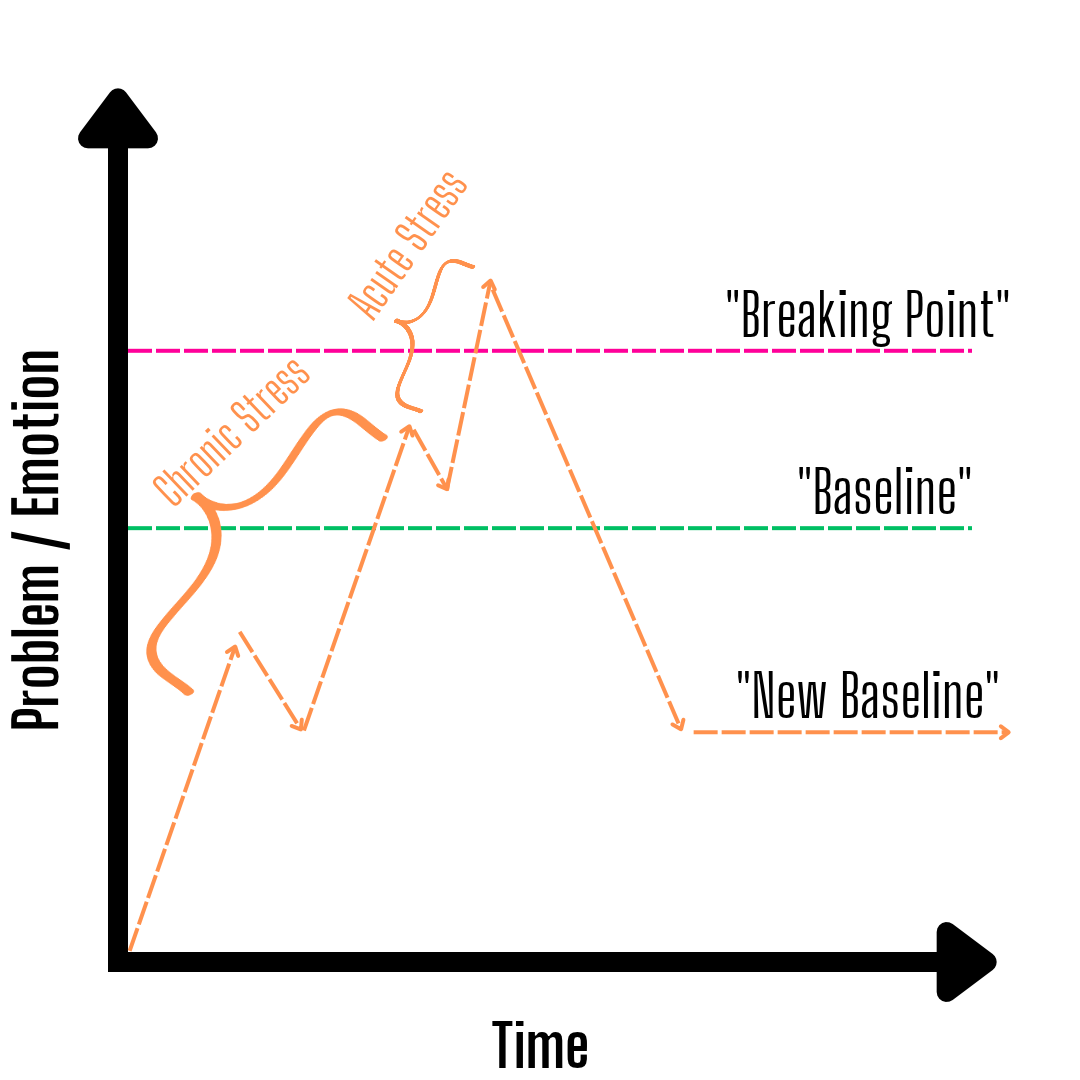
The graph above is a simple illustration showing that chronic stress (or stimulation) accumulates over time. Generally, we might call this our “baseline” — where we are “normally” at most days.
Occasionally, there are sudden or acute stressors that compound on top of our existing “allostatic load” (total stimulation input).
The point of “skills training” for our purposes here is to:
Navigate acute stressors, and
Establish a lower baseline.
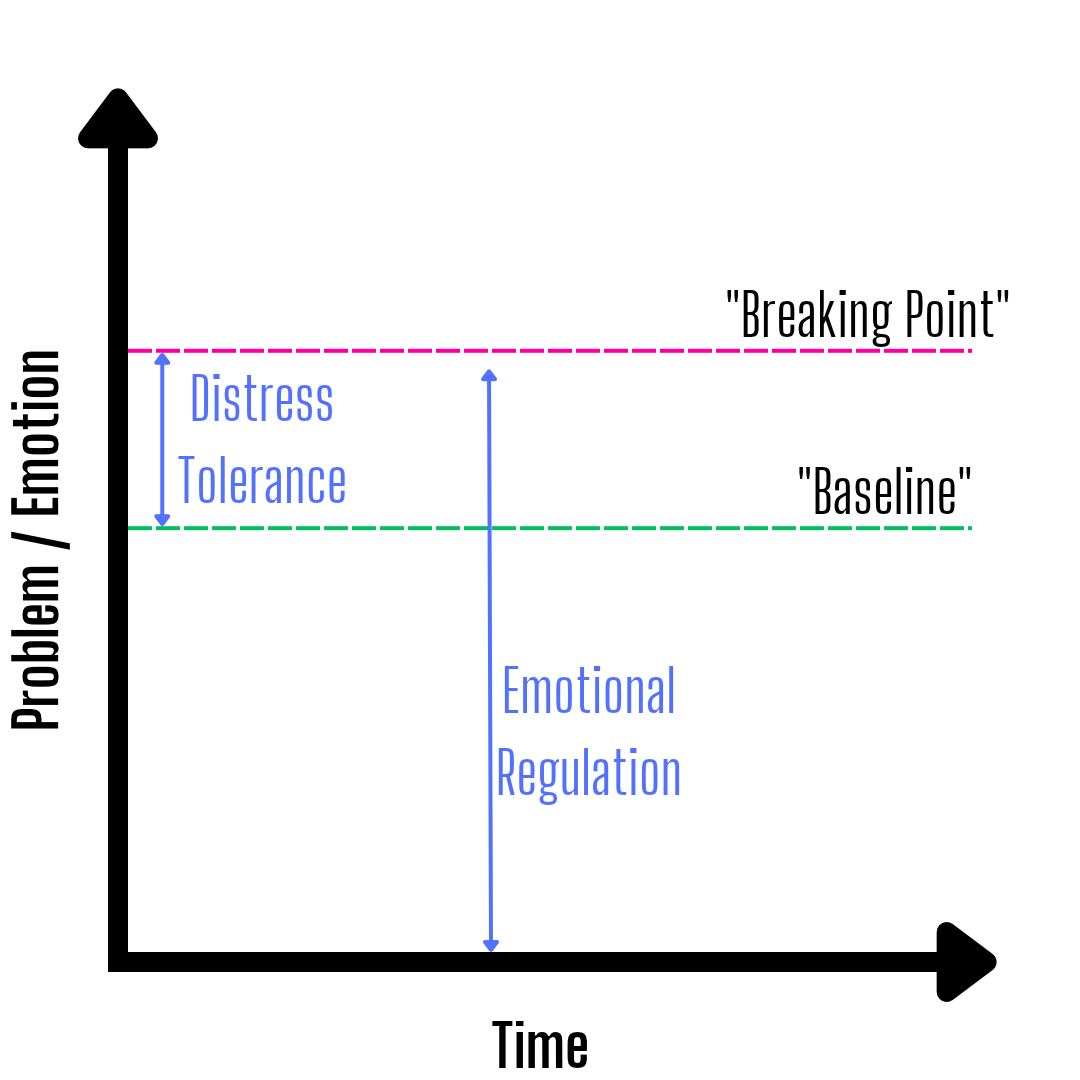
No matter how good we are, or think we are, at tolerating or managing stimulation (or stress), we all have a breaking point. Again, without getting too clinical, we can generally make two assumptions here to assess our respective needs:
If my “baseline” is too close to my breaking point, I will be getting “triggered” all the time. This is a distress tolerance problem.
If my breaking point is too low, I’m extremely volatile in all directions. This is an emotional regulation problem; which usually induces a distress tolerance problem as well.
Zooming out to the sporting world for a second, we talk a lot about training and recovery. The latter has gotten a lot of buzz in recent years — rightfully so. Even without the gadgets and “hacks”, the language we use to describe this process misses the mark.
Training and recovery are not binary states — an on-off switch. Good programming reflects this gradient. Just like you don’t drive by romping on the gas and then stomping on the brakes.
This is “dialectics” — the idea that two things are true at the same time. Hence one of the central tenants of Dialectical Behavioral Therapy is “wise mind”, the overlap of our rational and emotional mind.
Similarly, Polyvagal Theory reminds us that our central nervous system (CNS) is not a single up-down switch. There are overlapping gradients of sympathetic (SNS) and parasympathetic (PNS) activation.
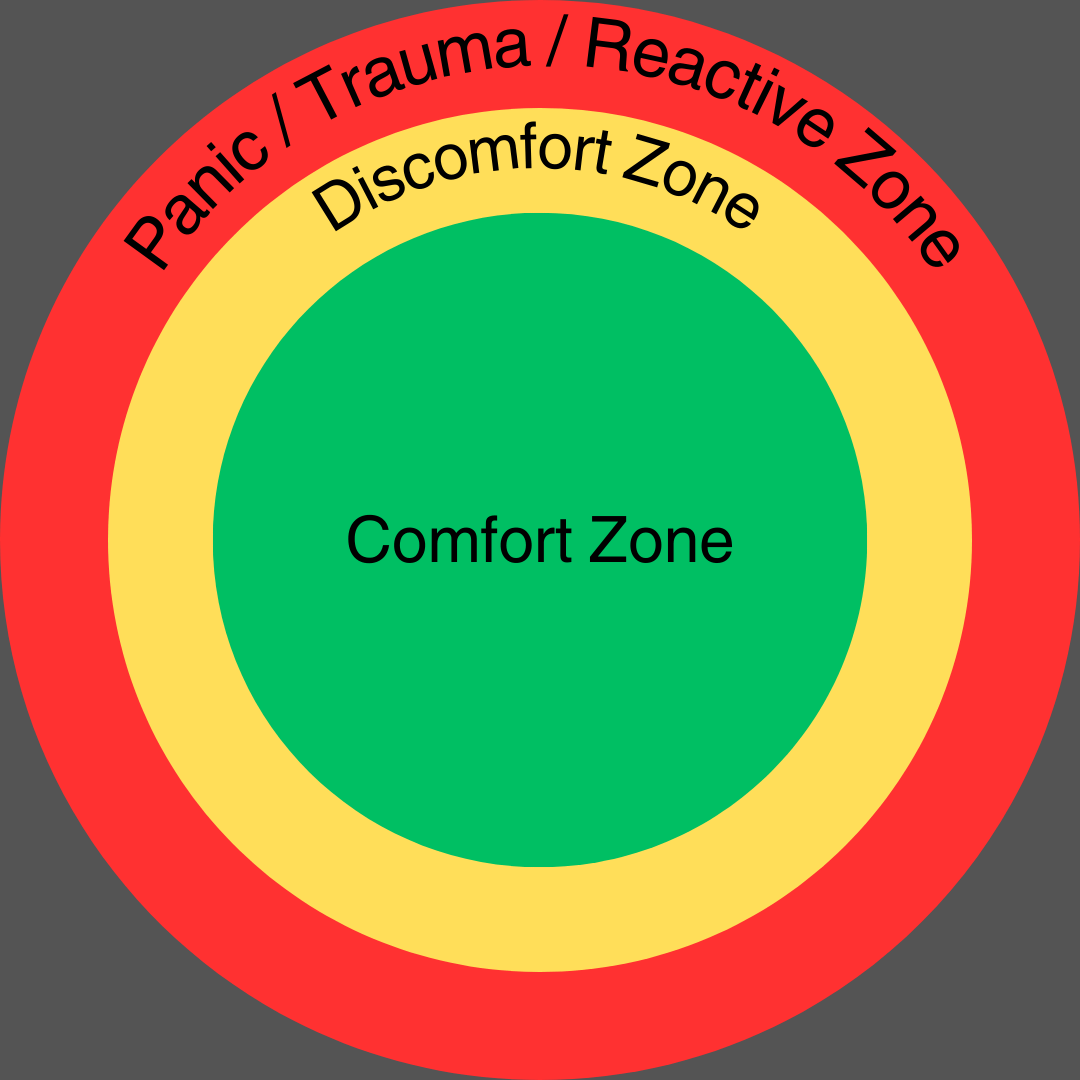
The “target” graphic above helps us understand this a bit better. If we stay in the center, our “comfort” zone, we think we’re staying safe. But, in reality, just like a muscle encased in a plaster cast, our ability to tolerate distress atrophies.
By contrast, if we plunge into the deep end, or the outer ring of the target, we recapitulate traumatic, reactive responses. Jargon free, Tony Blauer simply calls this “the oh-shit zone.”
To expand our (relative) comfort zone we have to carefully and intentionally engage with discomfort; in a way that pendulates between risk and reward to build confidence in our resilience.
That is to say, our ability and willingness to change.
Supporting Models:
Another name in the pantheon of trauma treatment is Peter Levine and his establishment of Somatic Experiencing International (SE).
One of the most fascinating things that I’ve observed throughout my career is that treatments that are proven effective tend to be convergent despite the language or rationale used to explain them.
In short, we figure out what works because it works, not because and ideology directed us to that point.
In this case, there is a tremendous overlap between what a DBT model describes as TIPP skills:
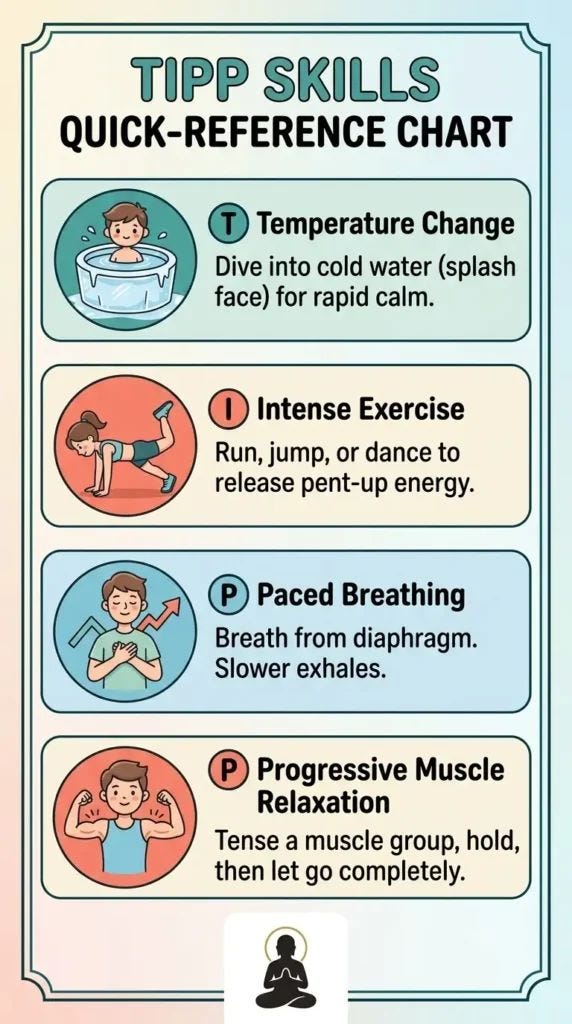
And what a SE model calls SCOPE skills:

What’s important to note here is not necessarily the differences, but the similarities. Both methodologies emphasize:
A connection to one’s body.
Self-soothing mechanisms.
Orientation to the outside world.
For what it’s worth, I prefer the SCOPE model when I am working with athletes because they tend to already have a hyperactive central nervous systems — hence more intense cold plunges or HIIT intervals are going to worsen the existing problem(s).
When we think of environmental hormesis (like environmental temperature exposure), we should consider that these generally correlate to physiological analogs similar to exercise:
Cold Exposure » Adrenaline, Cortisol » High Intensity Intervals
Heat Exposure » Serotonin, Dopamine » Low Intensity Steady State
If you’ve been paying attention, you know that more stress, more stuff to do, more hacks, more cognitive overhead, more fasting, more supplements, more optimization, etc… is just that; too much.
So, as a rule of thumb, whichever you’re innately more inclined towards, you probably need a large dose of the other to become more regulated. And, you guessed it, you can’t just stoke the fire with more stuff. You’ll have to choose what get’s (intentionally / mindfully) kept in and what get’s left out.
Theory Into Practice, Part 1:
On the field.
You may be thinking, “that’s all well and good Austin, but I’m here for the performance hack to get a leg up on my competition!” In which case, you’re going to be sorely disappointed.
The best counter-offer I can make is an invitation to get a leg up on the person you were yesterday… or at least last year. It’s a debt you’re going to pay in earnest as a gift to your future self.
I’ve written a lot about the importance of good warm ups and cool downs. I’ve also written a lot bout how high intensity sports (CrossFit and Jiu Jitsu in particular) neglect the former; and if one area was even more neglected, it would be the latter.
Most folks have come to the conclusion, sooner or latter, that training doesn’t actually make us better. We practice skills to get better, and training makes us weak and tired. Recovery, on the other hand, is when our tissues regrow and our memories (of things like motor patterns) are consolidated.
So, in short, by slamming on the brakes — to keep the car metaphor — or just hoping you coast to a stop after redlining, is not an effective recovery strategy. You’re cutting short your ability to improve.
I have three primary suggestions for this:
Before Practice:
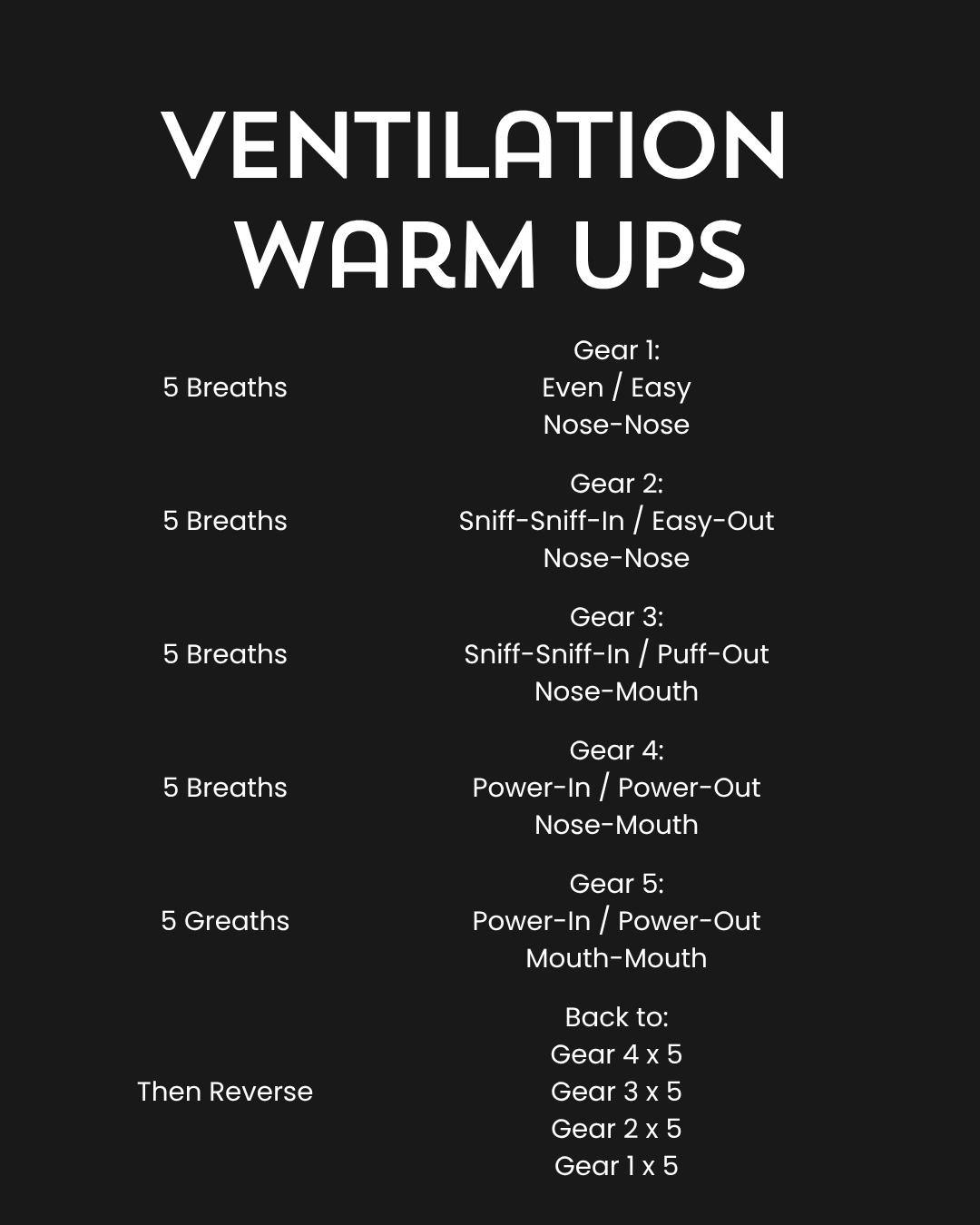
The idea here is that we want to get our brain engaged, our skin a little sweaty, and our heart pumping. What we don’t want is to feel exhausted. Nobody should be bragging about winning the warm up.
Plus, if we’re talking about a skills-based session, your brain literally cannot interpret and implement new information when it is in panic-mode.
Between Rounds / Sets:
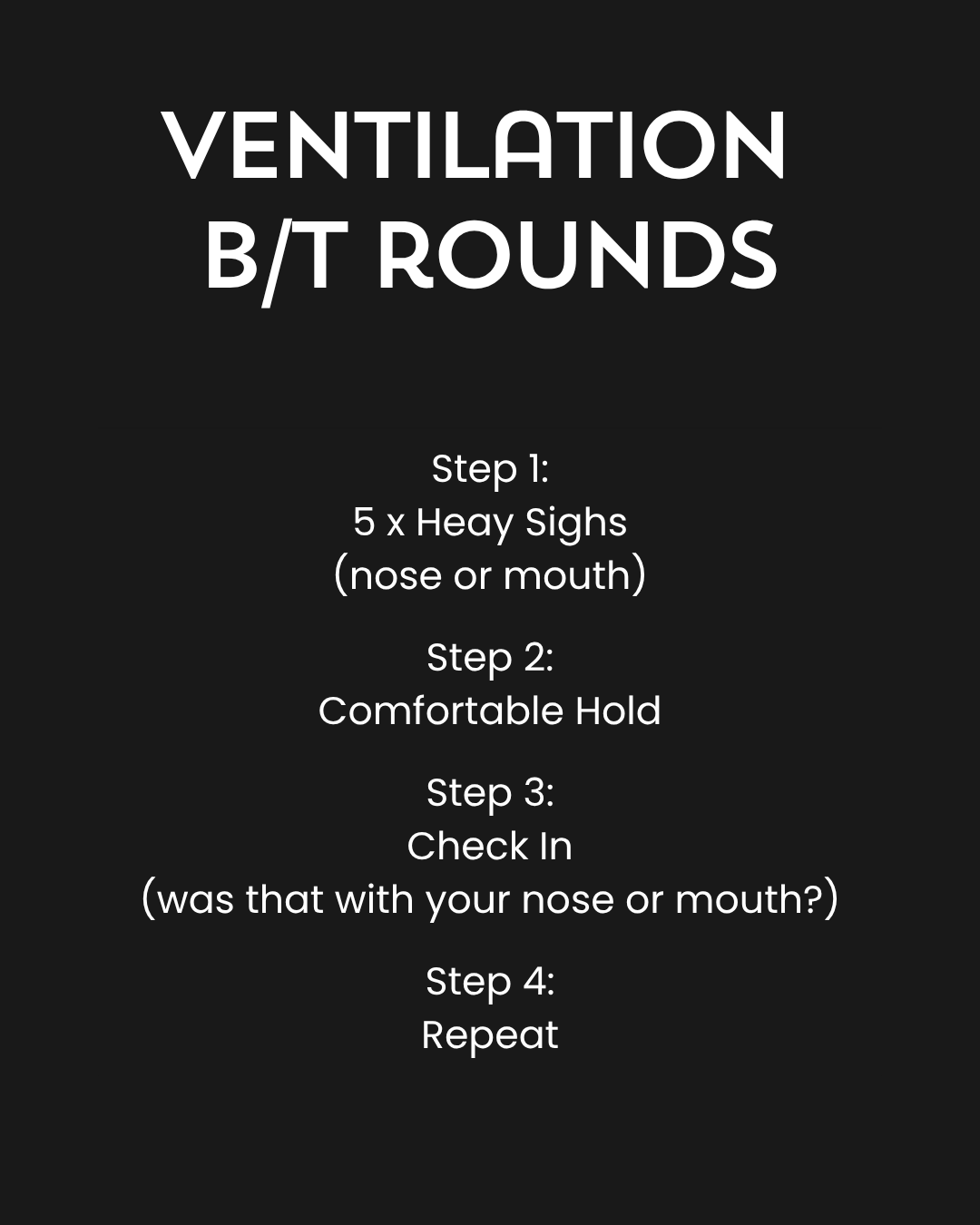
More advanced /complicated protocols exist, but they aren’t necessarily more effective. In fact, I’d argue that they’re less effective because complicated systems are more difficult to implement and sustain.
The only slight addition I’d make here is that you could continue the process depicted in the graphic until you can comfortably work back to nose-mouth breathing and then until nose-nose breathing.
After Practice:
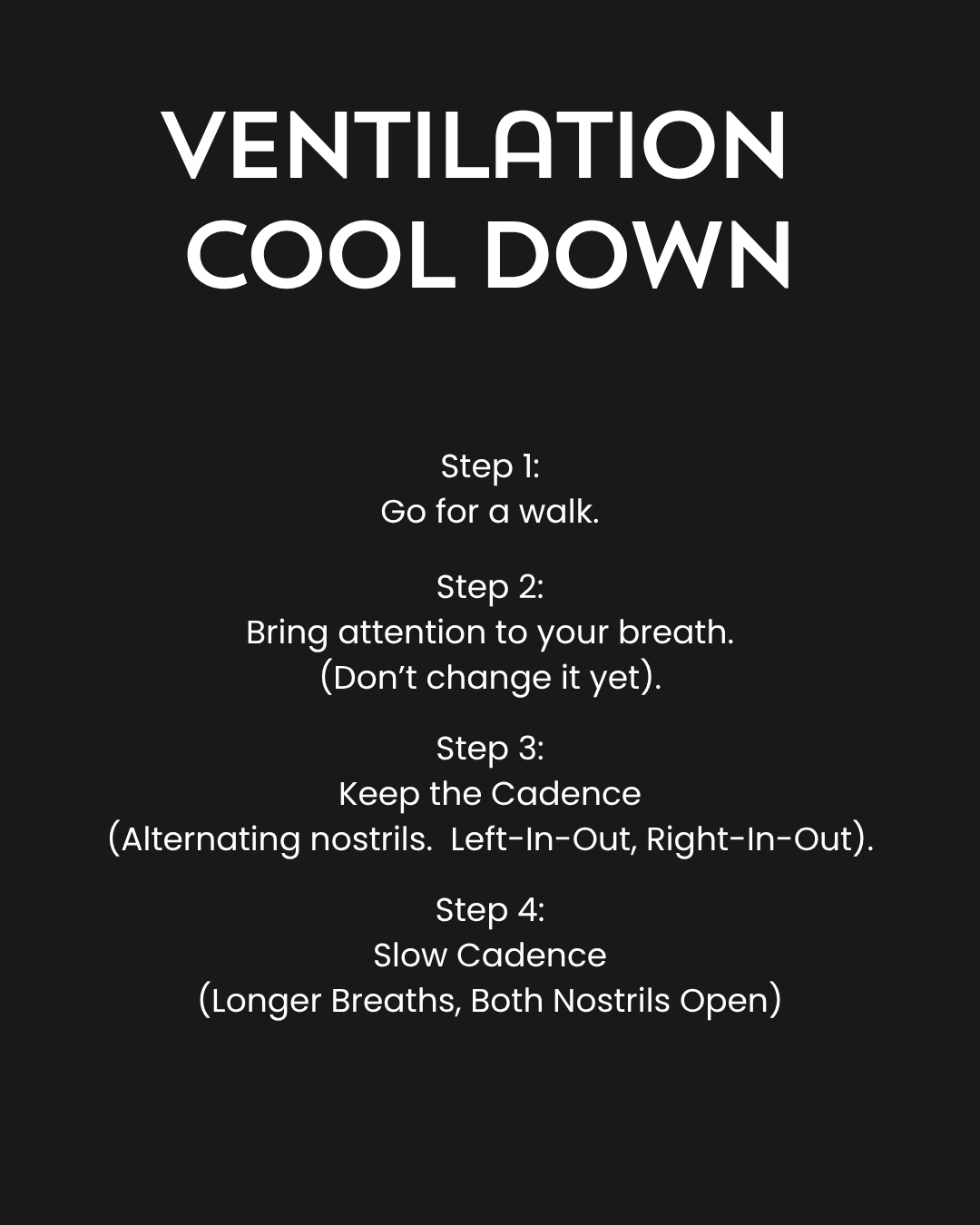
Here again, I’ve used a lot of different “gearing” protocols, but simple tools are easy to remember under duress. The point here is achieving a specific state of arousal, not adhering to an arbitrary cadence or protocol.
Remember, these practices are just that, a practice. Which means we’re putting money in the bank, not buying a lottery ticket. Don’t expect to put out a clickbait YouTube video titled “I Did This Breath Protocol for 7 Days.”
Do it for 700 days and get back to me.
Theory Into Practice, Part 2:
Off the field.
Most of an athlete’s life is spent off-the-field. That’s fascinating because we as coaches and athletes place so much emphasis on, and build our entire identities and self-worth around, what happens on-the-field.
It stands to reason then, that what we do off-the-field has a pretty big impact on our performance on-the-field. So, pay attention.
In theory we could apply the same upper / downer protocols we used for warming up and cooling down to waking up and winding down for bed. But, I want to give a little more breadth here.
Recall that breath was only one part of the TIPP skill. If you’re reading this, you’ve got intense exercise covered. So, let’s take a look at those “orienting”, “pendulating”, and “progressive relaxation” component — or what we can more generally describe as “grounding.”
Note: I’m all for being a barefoot heathen in the wilderness, but I’ll let other folks talk about EMFs, electrons, and copper shoe studs.
What I’m going to present here is a simple “time-out-check-in” procedure. It’s even more simple than the “Z-Method” meditation created by Emily Fletcher (author of “Stress Less, Accomplish More”).
That’s certainly not to say that my way is better, it’s just that I know myself, and virtually all of the people I work with have stressful jobs, high expectations, and train hard. We could all use a little time to check out and check in with ourselves.
Stop
Literally. Put the phone down. Back away from the keyboard.
Breathe
Just once. Then, one more, a little bigger. Now, a third time to really make sure we stopped.
Touch
Tactile connection. Scrunch your toes inside your shoes. Take your shoes off and touch the floor or sidewalk. Rub the frays on your pants pockets. Or give yourself a hug, this isn’t the place for judgment.
Observe
Look around. How fast or slow is the world actually moving around you? What problem really needs solved right now? Today? This week? Which ones are out of your control entirely?
Act
If you can fix it, fix it. If you need someone else to make it work, work on making it work with them. If you can’t do anything about it right now, make yourself feel better for the moment.
That process takes 60-seconds or less. Do it as often throughout the day as you like or need. I’ve implemented it with everyone from professional fighters to architects and ice road truckers. Meal times and / or bathroom trips are excellent existing behavioral routines to “stack” this on top of.
Summary & Conclusion:
The long and the short version is that everyone has limits, no matter how tough you are or how much you pride yourself on eating glass, everyone breaks eventually.
The point is that you don’t have to wait for that to happen. There is no magic. There are tools that will take practice to plant the seeds and reap the rewards of.
You will have to pay attention. Clogged drains don’t unclog themselves.
You will have to be patient. You did not dig yourself into this hole overnight, nor by coincidence or luck. That’s not how you’re going to get out either.
You will have to be gentle. Everyone loves a winner and to feel competent. No on likes a screamer or a liar.
Looking for a guided and personalized approach to your fitness training that builds a better vessel for achieving physical outcomes?
Or stay up to date for free with the Savage Zen Athletics Newsletter!