

“Strength” and “conditioning” are two of the most often used, yet misunderstood words in the world of sport performance. Particularly, in grappling sports we have a conundrum. Our sport is fundamentally based on grabbing (holding and controlling things). Yet, we cannot escape the fact that “fatigue makes cowards of us all” as Vince Lombardi put it.
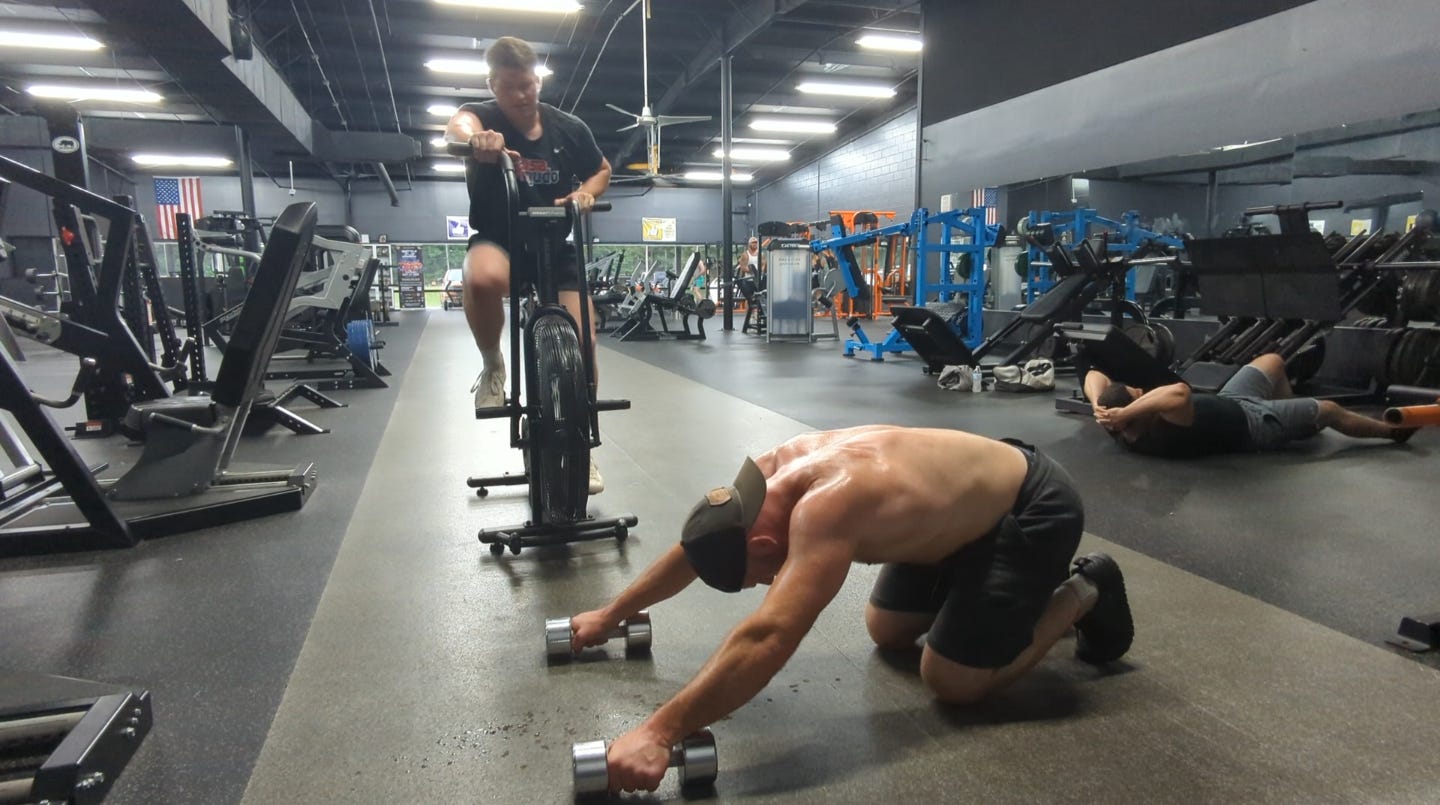
We all know, traditional “conditioning” methods — which for more people is a default to low intensity steady state (LISS) training — offers very marginal direct returns inside a grappling context (of varied energy systems and “repeat sprints”).
Further, we’ve all heard the outright lie that “technique conquers all” endlessly espoused. That’s a lovely sales pitch, but sooner or later we all find out that physicality is a weapon, a tool, and one that we should train and leverage to our advantage.
First, we need to establish some operational terms.
Strength is the ability to generate and hold tension.
For this reason, I usually don’t differentiate between strength and mobility in most of my training programs.
Conditioning, then, isn’t as simple as “endurance”, unless you’re sport is specific to that experience of persisting. What we’re mostly talking about, then, is capacity relevant to loads and duration relevant to our sport.
Conditioning is the ability to produce work (load and duration) relevant to our field of play (or work).
At the highest level work capacity is simply defined by work divided by time. Operationally, this may look like:
How fast can I complete a static workload? (e.g. Run 5 Km or do 300 burpees “for time.”)
Do more work in a static time frame (e.g. AMRAP, as many reps / rounds as possible in 10, 20, 30, 60 min, etc.).
Power, which requires letting go, and hypertrophy (the ability to change ourselves) are inherent bridges between how “strength” and “conditioning” are expressed.
I should also note that I’m a strong critic of “weaponized specificity” and other types of proprietary nonsense — shrimping sled pulls come to mind. This creates a situation that looks like a duck, maybe quacks like a duck, but offers virtually no return on our ability to do duck things.
In other words, it’s an ineffective middle ground where neuro-muscular movement patterns (technique) actually lose their specificity and energy system efficiency (conditioning) is obfuscated.

Strength: Easy Gaps to Fill
I am a huge proponent of strength training for all athletes. As mentioned above, I don’t differentiate between strength and mobility training. The idea is that I want, particularly combat sports athletes, to consider “how strong are you if you cannot move yourself?”
If my sport was strongman and I need to be able to pick up a Honda Civic, then it would be helpful to be roughly the size of a Honda Civic. The same is true in combat sports where, go figure, moving something roughly the same size as our body is extremely helpful.
Further, it is not so much the case that mobility training — as I define it — will magically make you immune to joint locks. It is that the less capable I am of moving myself, the easier it is for someone else to break me. Therefore, I must be “strong” in “weird” positions.
It should go without saying as well that, despite common stereotypes, strong does not imply dumb. Strong folks can learn the same techniques with the same proficiency as the not-strong folks. This leaves the not-strong folks in quite a dilemma should they find themselves in an open division competition — or even a regular training day.
The trouble here is that because grappling sports are literally based on grabbing, holding, and controlling an opponent, there is a very quick carryover from one’s ability to hold (strength) and their ability to grapple.
This seems to be particularly true for under / un-physically developed body types. For example, consider the massive array of different body types and maturation you find on a high school wrestling team; now extend that down to the youth division of your club and all the way up to the oldest person in your gym.
Can you really tell me with a straight face that being a little stronger, more mobile, and more capable of change isn’t going to be helpful to just about everyone?

Conditioning: The Real Bottleneck
Now we get to the sticky part.
My training logs show that I crossed the 2,500 hour mat time milestone in September. Never once, after any training round or competition, has anyone ever told me;
“You know what Austin, you’re feeling kind of scrawny. I think you need to hit the weights more.”
Yet, somehow, I’m sucking wind every single Wednesday and Saturday. It’s almost like hard rounds are, well, hard; and putting the pedal down is always exhausting regardless of how fast you’re going. To top it off, you’ve probably never lost a match because you couldn’t squeeze tighter.
There are countless examples (in fact many top competitors make this their entire strategy to exploit) where exhaustion causes people to make poor technical and tactical choices that cost them the match.
While strength may give us the quickest return on investment, it has the lowest ceiling. You don’t have to take my word for it though. Let’s do an experiment:
Pull up YouTube and search any match. Literally any match, any style, any weight class, any skill level.
Get a piece of paper. I want you to guess what the bench, deadlift, and squat totals are for each athlete.
Then, I want you to simply observe who gets tired faster.
Even for an educated eye, guessing the powerlifting totals would be pretty difficult. Yet even an untrained person can see who’s generally fatiguing faster. For the record, the stronger person could also be the better conditioned person (which is the point of this article), and there are myriads of reasons to win or lose a match (which is beyond the scope of this article).
If we polled 1,000 black belt matches and made the same guesses, do you think the hypothetically stronger athlete won more often than the one who got less tired (when they were different)?
How / do you think the results would be different if we watched 1,000 white belt matches instead?
What to do about it?
Improving our sport is primary.
I would strongly discourage lung-ripping aerobic capacity sessions every day. We must remember that improving at our sport is primary. Anything that is taking away resources that could be spent on the mat with real coaches and real training partners is a concession.
Build general capability first.
LISS is not useless. Humans are fundamentally aerobic creatures. Without oxygen you’re dead within minutes. So, our ability to exchange gas (i.e. respiration) is pretty important. The aerobic system is always running. A better aerobic base will help build more efficient recovery between sessions, rounds, and scrambles.
Metaphorically, if you’re going to romp on the throttle, you probably want a gas tank big enough to last the whole race, right? You also want to make sure you don’t end up stranded and walking (or limping) to the fuel station on your rest days.
Acquire relevant attributes.
Those general adaptations need to be converted to specific ones. Remember that strength-mobility overlap? If you wouldn’t drive a car with square tires, you shouldn’t try to “build a bigger engine” before the one you’ve got is moving well.
Cultivate throughput.
Once our machinery is moving smoothly we can start adding horsepower. With internal combustion engines, the limiting factor is never getting more fuel in, it’s getting more air. Our bodies aren’t that different.
In fact, you will probably find that the limiting factor is actually your in/ability to exhale (off-gas CO2) fast enough.
Create adaptive demands.
Lastly, we’re ready to move from the drag strip to the obstacle course where we’ll need to shift gears, both up and down, during a given encounter. This is where we’ve got a great game to play.
There are endless combinations of sprint-hold-grind cycles we experience on the mat / in the ring. What’s more is that, with a little creativity (and no need for obscure band and fascia fixations) we can produce almost exactly the same physiological experience in the gym.
That is the point of “strength and conditioning training.” It is not to replicate our sport in the weight room or track. It is to leverage an intentionally synthetic environment to isolate and cultivate specific physiological variables.
Sample Session:
EMOM / 4 min (every minute on the minute):
Bike x 10 calories
Power Clean x 2 (bodyweight)
Front Rack Hold x remainder of minute
Rest 4 minutes.
Repeat.
Rest 4 minutes.
Repeat.
Rest 4 minutes.
Repeat.
*If you’re feeling frisky, you can add a couple calories to the bike each round..